Dive Brief:
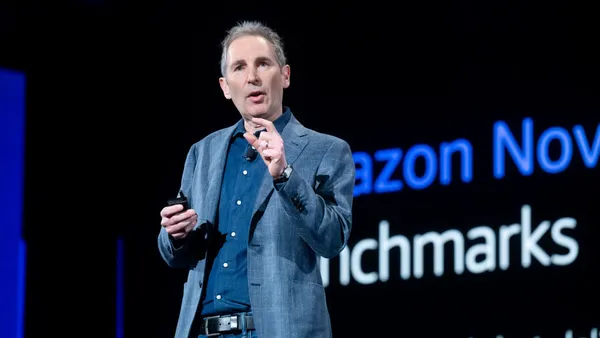
- Amazon President and CEO Andy Jassy stumped for the company's $200 billion capital expenditure plan for 2026 in a Thursday letter to investors, citing a compute bottleneck hindering AWS' growth and future customer commitments for significant portions of upcoming capacity.
- “AI is a once-in-a-lifetime opportunity where the current growth is unprecedented and the future growth even bigger,” Jassy said. “We’re not going to be conservative in how we play this — we’re investing to be the meaningful leader, and our future business, operating income, and [free cash flow] will be much larger because of it.”
- In addition to added revenue for AI services, the company’s betting on further growth through its chip business, which reached a revenue run rate of $20 billion with the deployment of Graviton processors, Trainium accelerators and Nitro cards in support of AI compute.
Dive Insight:
As the dominant cloud provider in terms of market share, AWS is closely watched by CIOs aiming to deploy AI services — but it's not the only one accelerating capital expenditures.
Hyperscalers are sparing no resource to fuel an expansion of compute availability as they compete over enterprise spending. AWS, Microsoft and Google — the top three cloud providers — have laid out plans to invest more than $500 billion in capital expenditures this year, mostly in support of their AI expansions.
As Jassy noted in his letter, data center dollars don’t immediately translate into revenue.
“AWS has to lay out cash for land, power, buildings, chips, servers, and networking gear in advance of when we can monetize it,” Jassy said, providing a timeframe of up to 24 months before billing starts.
Jassy’s aggressive investment plan suggests AI demand growth is still accelerating and will likely exceed their projections, said Brian Alletto, a director in West Monroe's technology and experience practice.
“Add on their continuing core technology investment and it reinforces a clear message to customers that AWS is building for long-term scale and leadership in AI,” Alletto said in an email to CIO Dive. The company’s existing scale as the dominant provider will help it continue to innovate and expand relative to smaller players, according to Alletto.
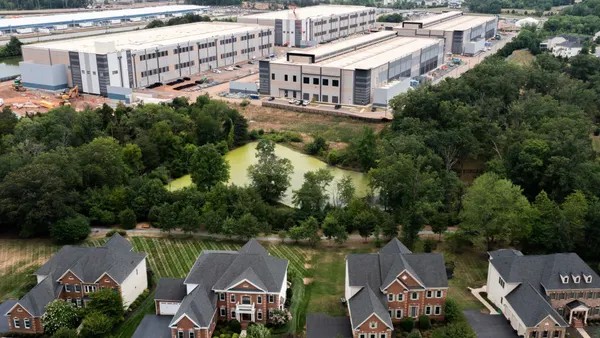
As data centers pop up across the globe, hyperscalers have sought to invest in local communities to offset pressure on critical infrastructure. AWS announced a $25 billion investment plan in Mississippi on Thursday, including $300 million aimed at power grid improvements.
Tech leaders are tracking the growth spurt in cloud capacity, hoping to get a sense for how vendor dynamics will affect their future access to compute.
“CIOs consuming AWS services should be thrilled that Amazon is investing heavily in its infrastructure,” Scott Bickley, advisory fellow at Info-Tech Research Group, said in an email. “With new deals inked with OpenAI and Anthropic, plus their own proprietary models bolstered by options around low-cost training (Trainium) and inference (Inferentia) chips, they offer a suite of options to meet most workload use cases.”
The push-and-pull in the vendor market will help dictate future dominance, Bickley added.
“Every deal Amazon gets today is a deal a Microsoft or Google or Oracle is not landing,” said Bickley. “It is a blocking strategy as much as a capacity building approach to the AI market.”