Dive Brief:
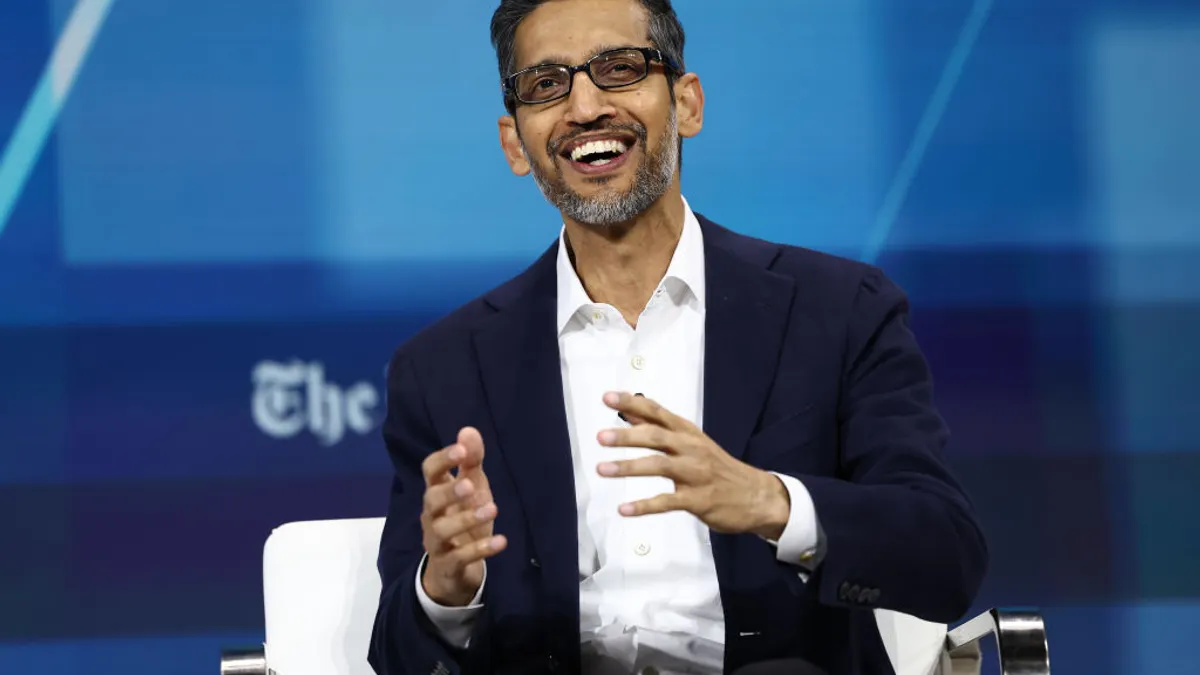
- Alphabet is charging forward with its push to expand AI capacity, citing rising customer demand and supply chain constraints, executives said Wednesday during the company's earnings call for Q4 2025.
- Google Cloud's parent company forecasted capital expenditures to reach up to $185 billion in the 2026 fiscal year, more than double the $91 billion it spent in fiscal 2025.
- “We’ve been supply constrained even as we've been ramping up our capacity,” said Alphabet CEO Sundar Pichai during the call. “Obviously, our CapEx spend this year is an eye toward the future … we are constantly planning for the long term and working toward that."
Dive Insight:
Alphabet is not alone in its aggressive investment push to support compute. In the last four years, hyperscalers have nearly doubled the amount of revenue they're spending on capital expenditures, from less than 9% to 16% in 2025, according to data from Synergy Research Group.
Amazon, which is set to report earnings after market close Thursday, said in October it expected capital expenditures to reach $125 billion in 2025, increasing in 2026. During its most recent quarter, Microsoft — which begins its fiscal year in July — said its capital expenditures had reached $37.5 billion, with most of the spending driven to support compute demand.
“The companies making those investments are titanic in nature and they are focused on markets that will continue to grow rapidly over the coming years, as shown by our forecasts,” said John Dinsdale, chief analyst at Synergy Research Group, in a report last year.
In addition to addressing capacity constraints, Google's rising investments are further encouraged by soaring Google Cloud revenue. The unit saw revenues rise 48% to $17.7 billion during the final quarter of the year, said Anat Ashkenazi, SVP and CFO at Alphabet.
“We’re investing in AI compute capacity to support frontier model development by Google DeepMind, ongoing efforts to improve the user experience and drive higher advertiser ROI in Google Services, significant cloud customer demand as well as strategic investments in Other Bets,” Ashkenazi said Wednesday.
Google provides a turnkey environment for building AI applications due to their vertical integration, according to Scott Bickley, advisory fellow at Info-Tech Research Group.
Given the demand for compute and the capacity constraints hyperscalers are experiencing, Google represents “a nice overflow option” for enterprises, Bickley told CIO Dive.
Amid hyperscaler competition for CIO spending, Google is betting on its ability to consume its own products and services, including its line of tensor processing units, to support profitability.
“When you look at the underlying fundamental metrics, it starts to make a lot more sense than the headline number would lead one to believe,” Bickley said.