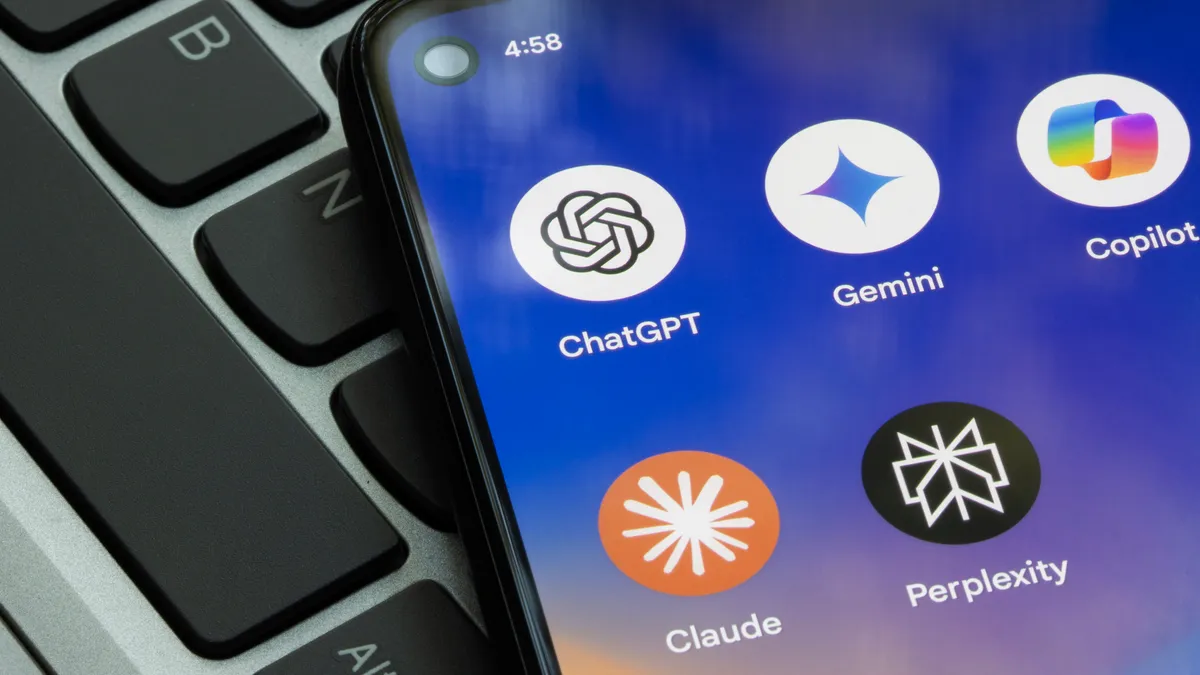
Speed is a key factor in enterprise AI adoption efforts. Some businesses rushed into generative AI, only to find a plethora of implementation barriers. Others, like Mary Kay, paused to assess the situation.
“When ChatGPT came out, that just changed the game overnight — it was the only thing that anyone wanted to talk about,” Mary Kay CIO James Whatley told CIO Dive. “We didn’t ignore it, but we didn’t jump all in.”
The beauty company credits its slower start in generative AI with clearing the path for adopting AI agents down the road.
“We knew once we had that foundation, that level of understanding, when the time came with the right tool and the right use case, we were going to be able to go faster,” Whatley said. “The worst thing you can do with AI is be naive about it.”
Mary Kay’s blended technology portfolio of generative and agentic AI is helping to build the digital toolset it wants to provide for customers, beauty consultants and staff, according to Whatley.
AI agents are already live in one market with plans for more areas and use cases in the queue. The company, like others exploring agentic AI, is leaning on trusted partners to usher in the new capabilities.
More than 2 in 5 companies were actively deploying AI agents in Q3, a sizable jump from the mere 11% of enterprises doing so in Q1, according to a KPMG report. Business leaders have high hopes for how the technology can boost operations, but caution is critical. The majority of leaders are trying to hedge risks by accessing agentic AI only through proven providers, keeping humans in the loop and limiting access to sensitive data.
“We have these partnerships with key vendors… and I’m leaning on them and taking advantage of their AI investment to benefit my customers,” Whatley said, pointing to Salesforce’s Agentforce offerings and Microsoft’s Copilot.
While off-the-shelf solutions give Mary Kay adoption speed, the company is also beginning to develop customized agents for its IT service desk and other areas.
“The agentic AI world is real and there’s true ROI, so it is going to be a part of our future,” Whatley said. “The use cases will only grow.”
Laying the foundation
Mary Kay’s early success with AI agents was only possible because it worked out the kinks before adopting generative AI.
“We’ve been focusing on transformation,” Whatley said. “We’ve been able to close down five regional data centers over the last couple of years, moved and modernized our tech stack from custom solutions into a modern platform and deployed that around the world.”
The custom code that the company wanted to retain was also migrated to different cloud providers, helping to clean up years of technical debt during a transition to a cloud-first model.

The projects changed workflows significantly and required a degree of upskilling among IT pros to handle the modernized tech stack. The rest of the business had to become familiar with the tools as well.
“There were many layers of change that we had to go through, and we had to do this at every single market as we deployed around the world,” said Whatley, who transitioned to the executive team as CIO in January 2023 after initially joining Mary Kay in 1998.
When the generative AI conversations started, Mary Kay quickly created and communicated an AI policy to communicate the dangers, especially as it relates to sensitive data. Shortly after, an AI committee was created to oversee implementation, ensure regulatory compliance and manage risks.
“From three years ago to today, there’s a ton of tools out there,” Whatley said. “They’re not all great. We have to ensure that whatever we invest in, we get the ROI on.”
AI governance wasn’t an afterthought; it was the foundation of all the projects to come — and Mary Kay’s AI initiatives are better off for it, according to Whatley.
“Committees and governance have a bad perception out there that it just slows things down or it's no gain, and that’s definitely not the case here,” Whatley said. “It has helped us consolidate the usage of approved tools as opposed to being scattered across groups and countries and that’s been very advantageous for us.”
The focus on governance has also helped project prioritization efforts. Before a proof-of-concept is even approved, the committee requires tools to prove their value in a sandbox environment.
“A lot of times, it doesn’t pan out — what’s being sold is not what’s delivered,” Whatley said. “We’ve been able to be cost-conscious from that perspective and really been able to make progress without losing a lot of ground as well.”
AI use cases
Amid adoption efforts, leaders are looking closely at the intersection between AI and productivity.
Mary Kay has reviewed manual, repeatable tasks and assessed where AI could step in. Code generation, video translation and image creation are a few of the earliest use cases that have proven valuable.
“Our goal is to get everyone understanding AI enough to help them in their specific role,” Whatley said. “In order to get there, you need more grassroots-type approaches to share the power and the risk of it.”

Mary Kay hosted a monthly series for teams to showcase potential use cases and foster discussion. One event in November drew more than 150 people, Whatley said.
The company is also exploring customer-facing use cases, such as its AI Foundation Finder. The tool, which launched in August, uses AI to identify 151 facial feature points, analyze the user’s skin tone and match it to the corresponding Mary Kay foundation.
“There was a tremendous amount of testing,” Whatley said, pointing to both internal teams and third-party reviews. “The model was tweaked many times until we felt like it was right.”
Companies are often more cautious about AI use cases that are customer-facing. Accuracy needs to be higher, and the tolerance for hallucinations is lower.
The tool has been used more than 185,000 times, according to the company. Teams are working on future iterations that can simplify the shopping process, allowing customers to add the foundation to their cart and purchase after being recommended.
“We’re continuing to tweak the model, and that’s the way this works,” Whatley said. “It’s only going to get better from this point forward.”