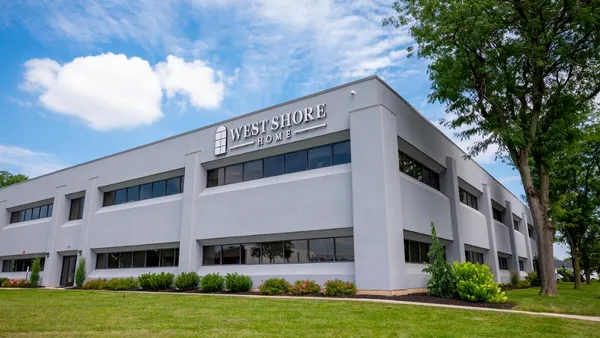
When West Shore Home tapped Eppie Vojt to serve as its first chief data and AI officer, operations were already tech-driven. The home remodeling company was well-versed in using lidar to scan locations and 3D visualizer software to create detailed representations of future projects.
But automation opened the door for operational improvements, said Vojt, who held several C-suite roles at self-storage software company Storable, including as its chief AI officer, before joining West Shore Home in 2024.
“Artificial intelligence isn’t a thing that we’re trying to slap on to check a box or indicate to investors that we do AI,” said Vojt in an interview with CIO Dive. “The only reason that we engage in AI-based initiatives is because it helps us achieve the core purpose of the business more effectively.”
Based in central Pennsylvania — where Vojt grew up — the company focuses on quick-turn projects such as flooring installations and bathroom remodels across more than 20 states and earned nearly $1 billion in revenue last year.
As the company looked for areas to improve through automation, finding ways to provide customers with accurate project completion estimates emerged as a priority.
“One of the biggest friction points in the traditional home remodeling process is that there is a lot of space for uncertainty,” Vojt said. The company developed a proprietary system called Sapos, which stands for schedule at the point of sale, that uses AI to analyze factors that influence time to completion — from how long certain vendors take to deliver supplies to permit requirements in a given locality.
“Ultimately, that means we can give a firm install date within seconds of committing to the project,” Vojt said. Last year, the tool helped create estimates of completion for 25,000 jobs, or nearly half of all projects carried out by the company, according to Vojt.
Building up adoption
Despite the broader construction industry's reputation as a tech laggard, the sector has leaned into AI adoption in search of operational efficiencies.
Most contractors surveyed by Dodge Construction Network last year believe AI will have a profound effect on the sector. More than 4 in 5 expect the technology will cut down on repetitive tasks, while three-quarters anticipate that the technology will help them gain insights on past projects.
But another survey by the Royal Institution of Chartered Surveyors found that adoption plans are lagging. Nearly half of the more than 2,200 global participants said their companies have no AI implementation efforts underway, and 34% are still in the early pilot phases.
To succeed in AI deployments, Vojt recommended technology executives have a sharp focus on what the tool can do for employers — and what rote and unrewarding processes it can remove from to-do lists.
“Expressing everything in terms of its business impact and focus on the customer is really powerful in delivering engagement and building buy-in within the organization,” Vojt said.
Cross-functional collaboration is also key to gaining employee trust.
“The CAIOs of the future need to be better at integrating themselves into the organizational fabric,” Vojt said. “Establishing good relationships with the leaders of the departments that they are working with and partnering with has become more critical than ever.”