

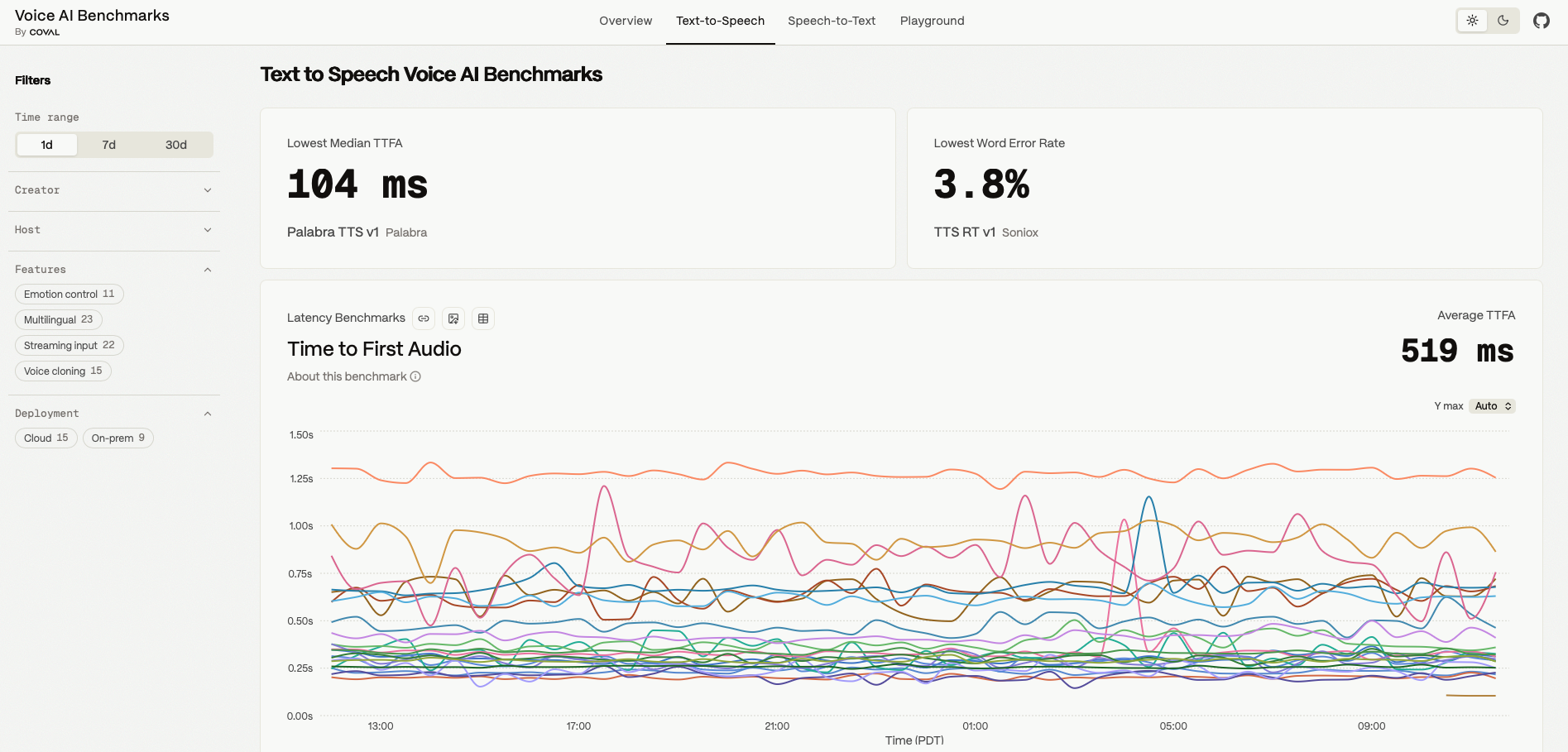
Palabra, a real-time speech AI company, has ranked #1 for latency on Coval's independent TTS benchmark, a widely watched, continuously updated leaderboard tracking how leading voice AI models perform under real-world conditions. Palabra posted 104 milliseconds of latency and a 6% word error rate (WER), outpacing ElevenLabs, Cartesia, and other major players in the space — roughly twice as fast as the nearest competitor.
Latency is one of the key factors determining whether a voice AI system can support a fluid, real-time conversation. Even when the generated voice itself sounds highly natural, a noticeable delay before each response can disrupt the flow of dialogue, creating awkward pauses, causing people to talk over each other, and making the interaction feel less immediate. Many voice AI systems still operate at around 500 milliseconds of latency or more. Palabra’s model achieves 104 milliseconds in Coval’s independent benchmark, significantly reducing the delay between turns and enabling a more fluid, uninterrupted dialogue.
Coval's benchmark is built to reflect production reality rather than idealized lab conditions: it measures Time to First Audio (TTFA) — the delay a listener actually notices, including any silence before the first audible sample — using pinned, versioned datasets so every provider is scored against identical inputs. Word error rate is calculated by transcribing each provider's synthesized audio with a fixed ASR model and scoring it against the original text, so the number reflects whether the speech is intelligible, not just fast. The full runner and methodology are open-source and independently reproducible.
"Latency is one of the most consequential metrics in voice AI," said Brooke Hopkins, Founder and CEO of Coval. "Humans respond in around 400 milliseconds, and systems slower than that feel unnatural regardless of output quality. What makes Palabra's result significant is what it creates downstream: when a model is this fast, every other component in the stack gets more time to think."
Palabra says the result reflects a new TTS architecture that achieves 35ms of time-to-first-audio before network overhead, paired with production infrastructure built to hold that speed at scale across large volumes of concurrent users.
"The biggest unsolved challenge that the world's leading speech AI labs are working on today is making interactions with AI voice agents feel indistinguishable from conversations with another person," said Artem Kukharenko, CEO & Co-founder of Palabra Al. "Latency above 200 milliseconds introduces a noticeable delay that disrupts the natural flow of communication. That's why we've focused on building TTS with extremely low time-to-first-audio that could work at large scale in production systems. In Coval's independent benchmark, we rank #1 at 104ms — the closest competitor is approximately twice as slow."
The TTS result is part of a broader focus at Palabra on real-time speech models — spanning text-to-speech, speech recognition (ASR), and speech-to-speech translation — built around low latency as a core design principle across the stack.
Palabra is a voice AI lab developing real-time models for text-to-speech (TTS), automatic speech recognition (ASR), and speech-to-speech translation. Its proprietary models and APIs enable developers and enterprises to build low-latency multilingual voice experiences across customer support, conferencing, live streaming, education, and other real-time applications. Palabra recently raised $8.4 million in pre-seed funding led by Seven Seven Six (776) with participation from Creator Ventures, and prominent angel investors including Max Mullen, co-founder of Instacart; Anne Lee Skates, former partner at Andreessen Horowitz; Mehdi Ghissassi,, former Head of Product at DeepMind; and Namat Bahram, an early backer of ElevenLabs.
Coval
Coval is the San Francisco-based evaluation platform for voice AI, founded by ex-Waymo engineer Brooke Hopkins. It builds independent, continuously updated, open-source benchmarks that measure how voice AI systems perform in production, rather than in idealized lab conditions. Coval recently raised a $28M Series A led by Norwest, with Twilio Ventures and Y Combinator also on the cap table, and is already trusted by over 60 organizations, including Zoom and Deepgram. Its public TTS leaderboard is available at https://benchmarks.coval.ai/tts.