

Dive Brief:
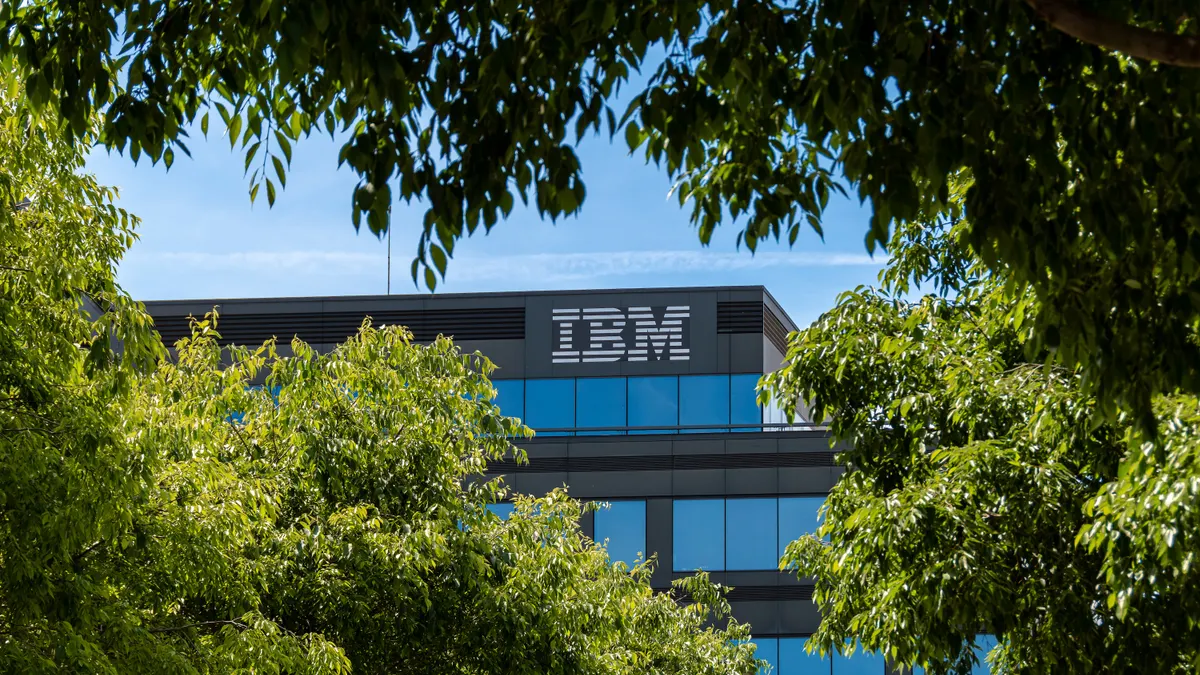
- IBM on Thursday launched Sovereign Core, a purpose-built software platform letting customers create, deploy and manage cloud and AI workloads under an organization’s own authority.
- Instead of adding sovereignty controls to existing architectures, IBM Sovereign Core “makes sovereignty an inherent property of the software itself,” the company said. Regulatory risks are pushing CIOs to adjust their infrastructure and innovation strategies to consider local data or sovereignty requirements.
- “It is addressing what we’ve seen for a lot of corporations, a lot of CIOs, is a major challenge,” Rick Villars, group VP of worldwide research at IDC, told CIO Dive. The platform will be available in tech preview starting in February, with full general availability planned for mid-year.
Dive Insight:
CIOs are facing mounting pressure to embed AI into processes throughout the organization. Yet AI deployment at scale can prove challenging, particularly for multinational companies facing digital sovereignty requirements in countries outside of the U.S.
Countries in the European Union, Canada, Germany, India, Australia and many more have enacted a wide range of laws governing digital infrastructure, often enforcing data localization requirements and other measures protecting data and technology infrastructure.
Vendors are responding. SAP, for example, deployed its EU AI Cloud in December to help support customers with their AI deployments in countries with strict regulatory environments.
Enterprises with a multinational presence are realizing that digital sovereignty requirements make it “virtually impossible for them to think about implementing consistency or scale in their AI investments,” Villars said.
Gartner predicts more than 75% of enterprises outside of the U.S. will adopt a digital sovereignty strategy supported by a sovereign cloud strategy, according to a survey of 241 CIOs and IT leaders in Western Europe. Of those surveyed, 61% cited geopolitical factors as a driving force toward local or regional cloud providers.
Sovereign clouds can help companies meet local data requirements piecemeal, but often lack the consistency needed to replicate an AI investment across different parts of the organization, Villars said. It’s a significant barrier preventing enterprises from thinking about large AI deployments, he added.
“What IBM has announced for this system is an approach that allows companies to bring some of that consistency back,” Villars said.
IBM Sovereign Core is built on Red Hat’s open source foundation. It provides a customer-operated control plane allowing enterprises to maintain direct authority over operations, deployments and system configurations, the company said.
The platform enables ongoing compliance by generating evidence of data being stored and managed within a sovereign boundary and allows for AI model deployment, local inference execution and agent operations under local governance without exporting data to external providers, according to IBM.
Customers can deploy the product in on-premises data centers, in-region cloud infrastructure or via IT service providers.
“This is sovereign by design,” Priya Srinivasan, general manager of IBM software products, told CIO Dive. While the product’s compliance center will come pre-loaded with sovereign frameworks specific to each country with such rules, it also allows for customizations, Srinivasan said.
There’s not a singular fix for every sovereignty need — and IBM Sovereign Core isn’t as comprehensive as a full suite of cloud services, Villars said. However, the product is a standard building block allowing enterprises to construct data “islands in isolation” from the same foundation.
As CIOs struggle to manage AI deployments due to sovereignty constraints, hyperscalers and infrastructure companies will be looking to provide products like IBM Sovereign Core and SAP EU AI Cloud to navigate those challenges.
“Some of your most important customers, some of your biggest customers, some of the places where you’re most dependent on AI to have a positive impact, are going to be areas where having the ability to address sovereignty requirements in a way that is scalable is absolutely necessary,” Villars said.