

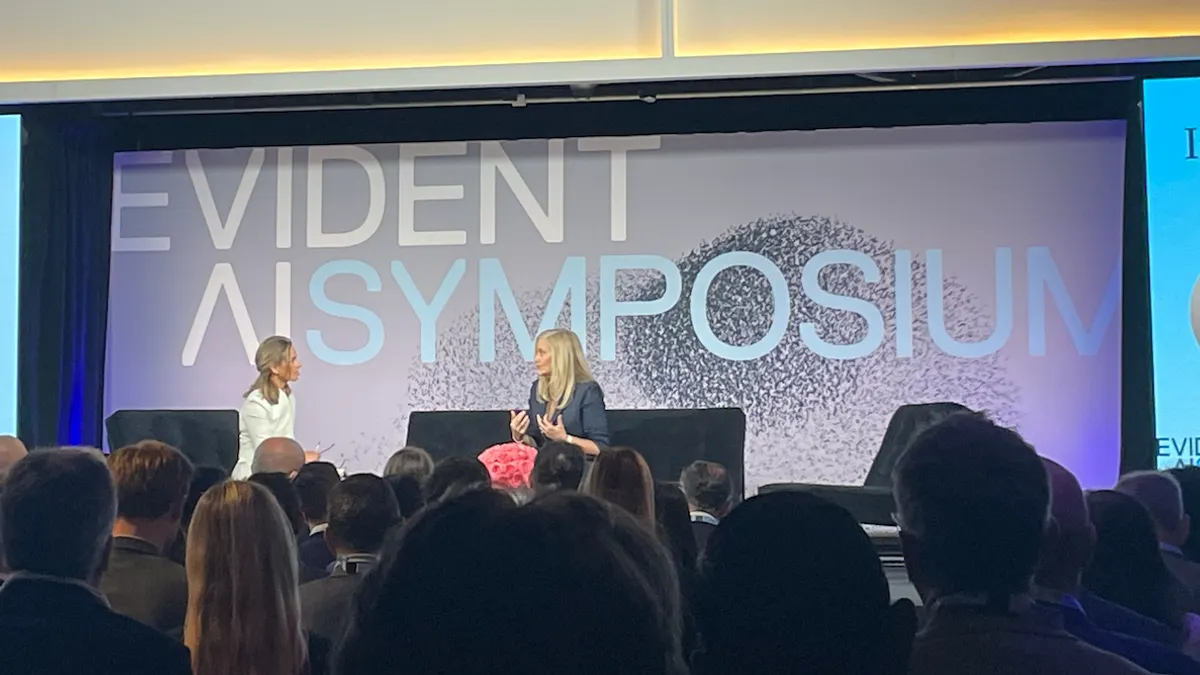
NEW YORK — JPMorgan Chase has accelerated AI use, building out its enterprise AI platform LLM Suite to support 1,000 business applications. But for Global CIO Lori Beer, security always comes first.
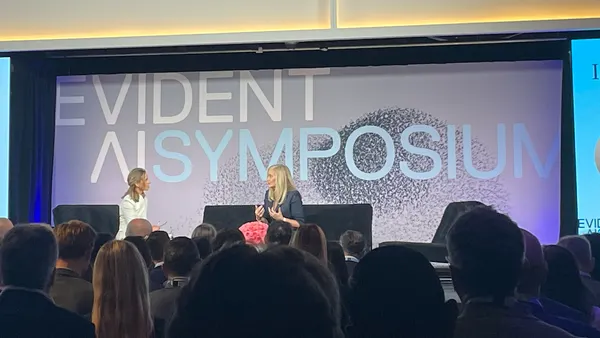
“We have to make sure security, how we manage risk, is front and center of everything we do,” Beer said, speaking Thursday during the Evident AI Symposium.
Beer’s remarks come in the wake of CEO Jamie Dimon voicing concerns about rogue agents and the bank’s move to prohibit outside agents from operating within its environment.
Across the financial services sector, leaders are grappling with the security implications of AI, especially as the technology evolves and agents proliferate. Aligning agents with enterprise standards and policies remains a critical challenge facing CIOs, said Marco Argenti, CIO at Goldman Sachs.
“You have to embrace the fact that any agent could misbehave,” he said. “They're not deterministic machines, they're stochastic machines.”
Tech leaders need to understand the risks of agents running within business environments, Beer said. Foundational technology controls such as identity and access management, privileged access and separation of environments need to be “best in class,” she said. Tech leaders also need to consider security controls “as you move software from a deterministic world to a non-deterministic world and it opens up new risk pathways.”
“We are going to start with one core agent-building platform,” Beer said, containing development to manage risk and allowing controls to be implemented at scale in an autonomous way. She said there is complexity to implementing guardrails and evaluations dynamically in real time, something the bank is working toward.
“This is one of the most important times to make sure you are appropriately balancing risk and innovation tradeoffs,” she said. “We want to move at speed, but sometimes we have to pull back to get controls in place. The technology is running ahead of capabilities to manage it.”
It’s not the first time JPMorgan has enacted a technology stop to get controls in place.
JPMorgan blocked ChatGPT when it first came on the scene in 2022 because people “didn’t understand the risk” of potential data loss, Beer said. The banking giant stood up its own ecosystem within its private cloud on top of Microsoft Azure to give data scientists access. This led to creation of its LLM Suite platform, actively used by 200,000 employees, Beer said.
LLM Suite now has the capability to complete orchestrated, multitask steps in a “highly JPMorgan-secure ecosystem where we’re confident with our data and how our data is being leveraged,” Beer said.
While focused strongly on security, AI cost management and delivering business value are also top of mind for Beer. Coding assistants account for the majority of the bank’s token spend, she said.
Beer said JPMorgan has shifted away from counting use cases to 50 strategic initiatives the business owns as a way to measure tangible value.
“It is incumbent upon us that the investments we make ultimately translate, not to a business case on paper, but real business growth, real business outcomes, and that’s the journey we’re on,” she said.
Bringing in forward deployed engineers
As agents rapidly evolve and drive major transformations across industries, Goldman Sachs teamed up with LLM provider Anthropic earlier this year to form an AI services company that embeds engineers within mid-size companies to implement and scale Claude.
“Obviously those companies are ahead of you,” Argenti said during the event. “In order to learn and compress the time of learning, having people directly from the lab working with your people is the best option to train.”
Once employees learn from the FDEs, the program moves on, Argenti said.
“It’s not the classic consultant,” he said. “This is a specific kind of engagement whose job is to become unnecessary in the shortest time possible and move to the next difficult problem. You come in, make sure the team builds the muscle, and then you can move on your own.”
Anthropic and Goldman Sachs aren’t the only companies betting on FDE programs. Google, Microsoft and AWS are spending billions to launch their own programs to embed specialized engineers within enterprise environments to help IT leaders scale the technology and move through bottlenecks.
If IT leaders maintain the perspective that AI agents could cause unexpected outcomes, the focus should then be on establishing containments and imposing rules for agents, as well as creating gates on user tools before the agent can make a transaction, Argenti said.