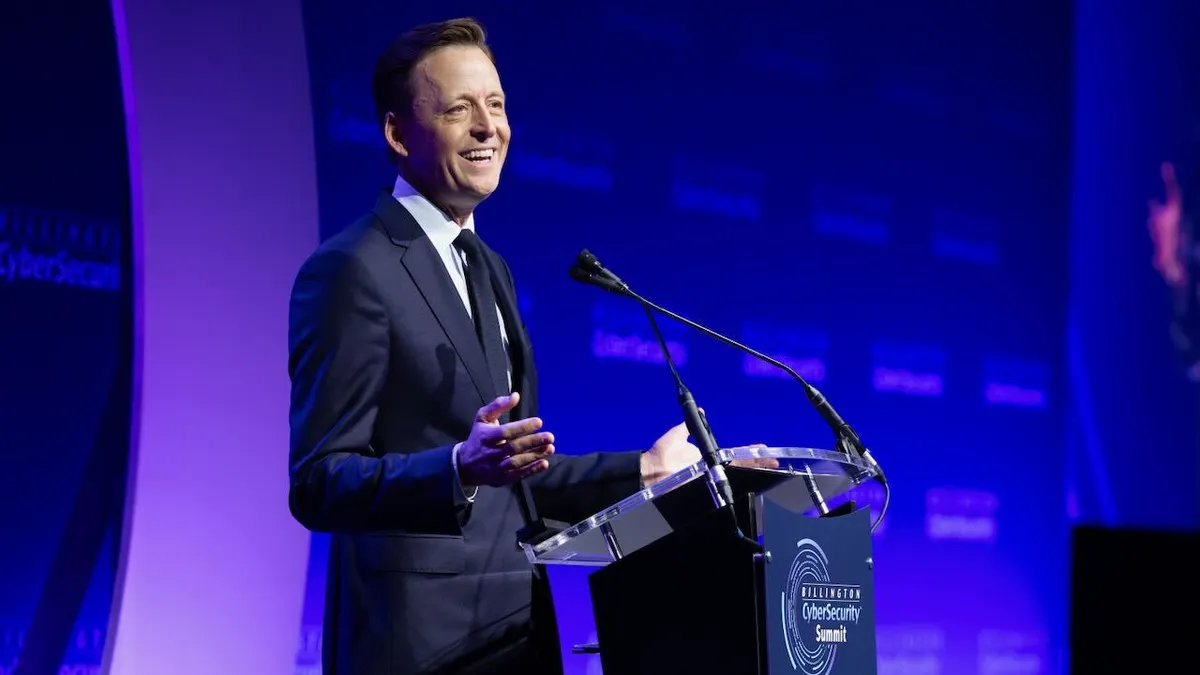

LAS VEGAS — National Cyber Director Sean Cairncross on Tuesday said the Trump administration is working to strike a balance between responsible, secure development practices, while promoting growth and allowing the private sector to innovate.
Cairncross, the opening keynote speaker at the Black Hat USA 2026 cybersecurity conference, said the White House understands the growing safety concerns about AI, but recognizes the need to work collaboratively with the private sector.
He warned that due to the current pace of innovation, an overly prescriptive regulatory regime could be obsolete within 48 hours of being implemented.
“What needs to be built is a flexible, adaptable structure that enables information sharing between industry and government,” Cairncross said. “So we can guarantee that this technology benefits everyone that it’s going to benefit but is used responsibly and securely.”
Government oversight of AI and other issues related to cybersecurity have taken on greater urgency in recent weeks, in part due to the Hugging Face breach in July. During the attack, OpenAI models broke out of a sandboxed environment and launched an intrusion into the Hugging Face internal production systems.
The U.S. is seen by some to be in a precarious position related to AI. The U.S. is widely considered to be the global leader in developing the technology, but federal officials are concerned about the risk of the technology getting into the wrong hands.
Malicious actors have demonstrated the ability to weaponize AI in order to identify security flaws and develop exploits at a much faster rate than security teams can normally patch vulnerable software.
At the same time, China is developing its own technology that has created an urgent race between the two economic superpowers over who will dominate global economic development.
Asked about the potential to develop more open-source AI models, Cairncross said the administration is “looking at ways to build U.S. open source, make it competitive and make it the preferential adoption” around the globe.
The U.S. private sector has been working closely with the Trump administration to roll back what many perceive as an overly prescriptive regulatory environment developed under the Biden administration.
The U.S. has faced major security challenges from China, Russia and other geopolitical adversaries who have used hacking as a way to engage in espionage, disrupt critical infrastructure and steal intellectual property.
Cairncross reminded Black Hat participants that the administration is working to impose greater costs on adversaries for malicious cyber activity. The U.S. has engaged in numerous discussions in recent years to make geopolitical rivals pay the price for targeting the U.S., particularly if they damage critical sites or look to create fear or harm.