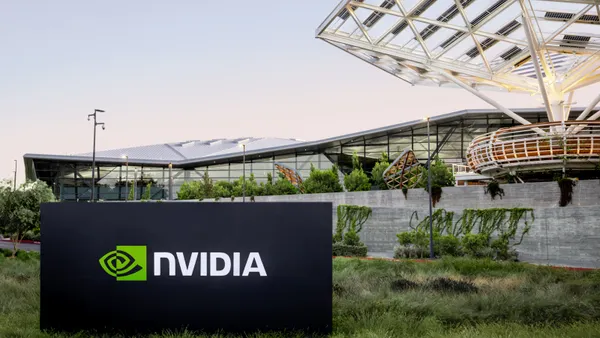


Technology vendors showed up in droves to this week’s Nvidia GTC conference in San Jose, Calif., highlighting deepening partnerships with the chipmaker and promising to help enterprises scale AI. In the end, the conference mostly served as a demonstration of Nvidia’s foundational dominance while leaving questions about AI returns unanswered, according to one analyst.
Jensen Huang, Nvidia co-founder and CEO, said during his Monday keynote that likely 100% of the global technology industry was represented at the conference, which is sponsored by approximately 450 companies, covering what Huang described as every layer of AI — power, infrastructure, chips, platforms, models and applications.
Huang said applications will drive the industry forward. However, Nvidia stands at the AI epicenter powering the infrastructure behind the applications, with the company now projecting $1 trillion in chip revenue through 2027.
“The significance of Nvidia here is pretty straightforward,” Alan Pelz-Sharpe, founder of market research firm Deep Analysis, said in an email to CIO Dive. “They are the picks-and-shovels merchant for the entire AI gold rush.”
Microsoft, Google, AWS, Oracle, Hewlett Packard Enterprise and Dell Technologies, among others, this week announced expanded partnerships with Nvidia to accelerate AI adoption. AWS, for example, said it plans to deploy more than 1 million Nvidia GPUs starting this year, while Google Cloud’s collaboration with Nvidia led to a co-engineered AI-optimized infrastructure-as-a-service foundation.
While major enterprise vendors tout expanded access to Nvidia infrastructure, it leaves meaningful differentiation at the infrastructure layer lacking, Pelz-Sharpe said. “They are all tied to the same scarce hardware,” he said.
“What we’re seeing this week isn’t really a series of groundbreaking partnerships,” he added. “It’s a tour of dependency.”
ROI question remains as Nvidia expands open models
Return on AI investments for enterprises remains elusive, and the announcements out of Nvidia GTC are about fostering the “potential for ROI” over showing how greater compute power solves business problems, Pelz-Sharpe said.
“The hype assumes that if you build the infrastructure, the value will come,” which is a dangerous assumption, Pelz-Sharpe said. “The ROI won’t come from the infrastructure itself, but from the ruthless application of AI to specific, high-cost business processes — something these announcements rarely address.”
Still, vendors aren’t ignoring the ROI question. Dell, which announced advancements across its AI Factory with Nvidia, said early adopters of the technology have seen up to 2.6 times ROI in the first year of adoption, including productivity gains.
For its part, Nvidia released a raft of products that spanned the layers of the AI stack, including an expansion of its open model families such as Nemotron for agentic systems and Cosmos for physical AI.
GTC keynotes aligned on the view that physical AI — the technology enabling autonomous vehicles, cameras and robots — is moving from pilots to early scaling, Charlie Dai, VP and principal analyst at Forrester, said in an email to CIO Dive. But for most enterprises, physical AI remains a “mid-term value story,” he said.
“While early adopters in manufacturing, logistics, and healthcare are already seeing productivity and safety gains, broad enterprise impact depends on overcoming integration complexity, safety validation, and cost barriers,” Dai said.
Nvidia’s open model expansion exemplifies the perspective that “open-source AI acts as a catalyst for enterprise AI adoption,” Dai said. Enterprises rely on open models and frameworks across AI infrastructure and agentic workflows “while pairing them with commercial offerings to manage risk and scale,” he added.
“Nvidia’s positioning of open models as a strategic enabler for agentic AI and physical AI reinforces the argument that openness is less about cost savings alone and more about interoperability, observability, and long-term control as AI systems become more autonomous, distributed, and operationally critical,” Dai said.