
AI introduces unprecedented challenges in data centers; not just in power, but in cooling, latency, deployment speed and geography. These challenges carry through all data center areas, or “subsystems,” to varying degrees.
These different subsystems often require tailored solutions in an AI data center, removing them from any semblance of a typical “uniform” design. Setting a foundation for a successful AI implementation requires a cable infrastructure partner with the capacity, agility and resources to deliver high-performance cabling systems designed for real-world data center environments. It also requires an understanding of how AI implementation interacts with each subsystem in the data center, and what the people responsible for maintaining those subsystems can expect.
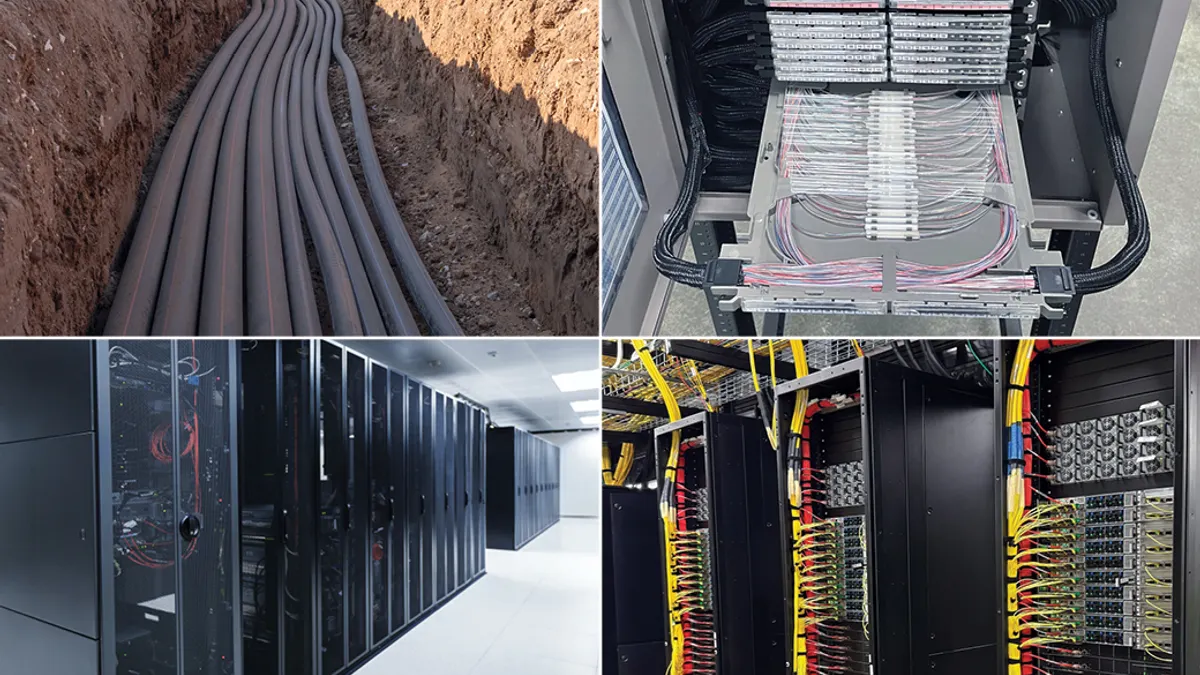
There are four key subsystems: the Entry Point, Front End, DC Interconnect and Back End Subsystems.
Entry point
The Entry-Point subsystem is traditionally part of the data center gray space, supporting infrastructure by connecting the cable coming from outside the data hall to the cable within it. Moreover, the entry point is where those fibers are separated and directed to different areas of the facility.
Increasing density demands from AI applications are driving increases of high fiber count cables coming into the Entry Point, and increasing power and cooling demands have further limited available gray space in the data center. This can cause complications for space utilization, cable management and labor, resulting in speed of deployment being the most critical issue related to the entry point.
So how can data center operators mitigate this issue? Rapid and versatile installation is key; innovative splicing enclosures, splicing and interconnect trays and consideration of pre-terminated solutions can be vital. These solutions unlock a modular approach to infrastructure, allowing for rapid and easy upgrades as needs evolve and require much less time to install overall.
Front end
The Front-End subsystem is typically in the white space, where the computing occurs inside the data center, and is the layer that handles traffic between users, internal resources and external networks.
Of the four subsystems, the Front End is least impacted by the addition of AI, buoyed above the waves that hit other subsystems by its established infrastructure. The Front-End Subsystem’s foundation has only received minor updates over the last five years. However, local code compliance is almost always a concern when expansions occur on the frontend, especially when those expansions are in other geographic locations. Global solutions can alleviate this concern, allowing you to utilize the same infrastructure across locations where local codes differ slightly.
Data center interconnect
The DC Interconnect subsystem is part of the data center’s gray space, or areas that provide critical support for computing, and often consists of multiple high strand count fiber cables running between facilities that connect pods across the network.
Somewhat ironically, AI struggles with the capability that the DC Interconnect subsystem was designed to deliver: connection over distance. An AI cluster on the back end is treated as a single system, housed in one location that then must spread itself over the rest of the facility. As the size of AI clusters increases, expansion of the data center interconnect system also grows exponentially to ensure that communication between facilities at maximum throughput. However, the data center interconnect system is notoriously difficult to expand, demanding time and labor to add or replace cabling.
Leaders can mitigate this issue by deploying infrastructure that can handle the higher densities AI requires, while also being built for rapid deployment. Leviton’s 1728-strand MMC trunks, which are part of the STRATA™ family of Hyperscale and AI data center solutions, allow for a much higher density footprint than traditional alternatives. Moreover, Leviton’s trunks are designed to be installed quickly and easily – a huge boon when recabling a traditionally labor-intensive subsystem.
Back end
Finally, there’s the Back End; the subsystem that houses the AI cluster, and where AI implementation really changes the subsystem’s status quo. As the density of the system increases to accommodate the AI cluster, cable management and power become critical. The substantial power demands of AI technologies require data center operators to find ways to do more with their established power infrastructure.
The challenge of managing the increased density is one that data center operators are familiar with; doing more with less. This is where Very-Small-Form-Factor (VSFF) connectors, like MMC, come in. VSFF connectors meet the need for higher density at connect points, while taking up less space than their MPO alternatives. This enables operators to scale fiber capacity without proportionally increasing rack space, as demonstrated by solutions such as Leviton's STRATA™ family, which supports up to 3,456 fibers per rack unit using a 16-fiber MMC connector.
As for maximizing the potential of established power infrastructure, utilizing power more efficiently in the data center often boils down to cooling. Immersion cooling is an emergent technology wherein servers are submersed in non-electrically conductive, thermally conductive fluids, offering almost-instantaneous heat dispersion for high-density networks. The success of immersion cooling depends not only on thermal performance but also on ensuring network infrastructure can operate reliably in submerged environments. Solutions such as Leviton TORRENT™ are designed to address this challenge by maintaining signal integrity and resisting degradation in dielectric cooling fluids.
For more insight on how AI will change the data center, as well as solutions developed specifically for AI and hyperscale data centers, read our white paper.
Learn how AI changes the data center, and how to address challenges for a seamless implementation.