


Despite agentic AI's potential for enterprise transformation, CIOs and other tech leaders face challenges deploying the technology in a meaningful way within their organizations, Tom Zehren, CEO of Info-Tech Research Group said at the company’s conference keynote Tuesday.
Security measures, IT budgets, AI strategy and employee buy-in all factor into tech leaders’ success with AI.
“We're living in a world where we have a significant tension between AI value creation on the one side and AI governance and risk management on the other side,” Zehren said.
Some organizations stay stuck with their AI adoption goals because of fear of risk, Zehren said. Saying no to AI projects blocks the risks, but it also blocks potential value, he said.
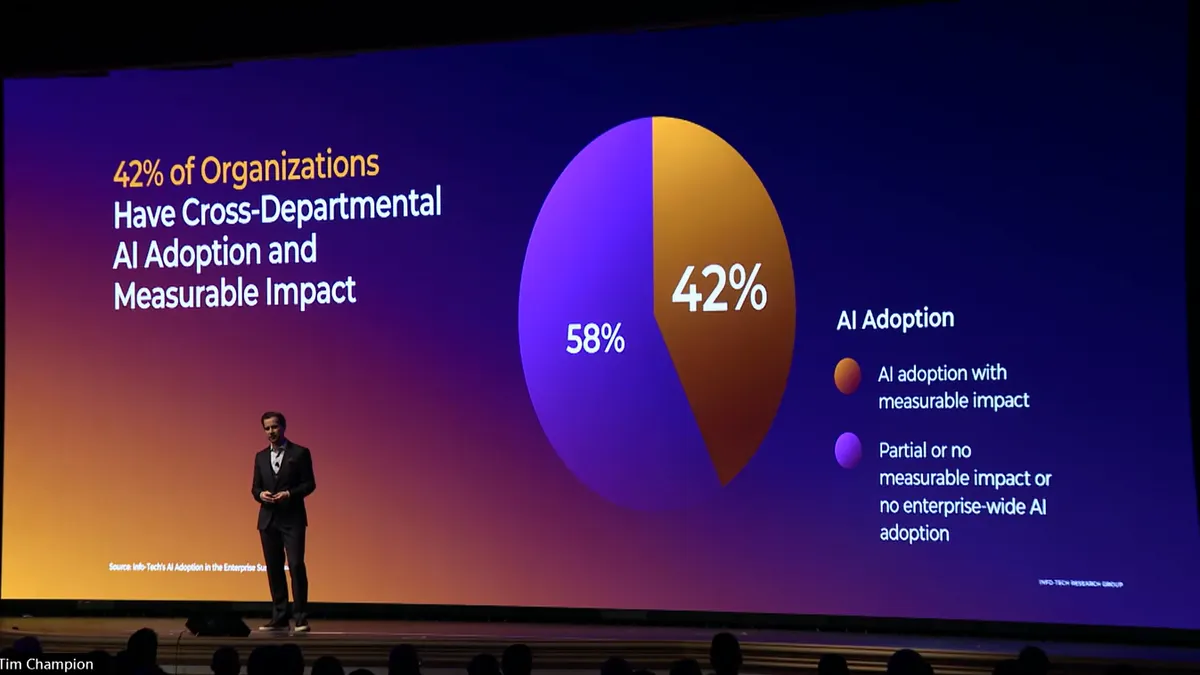
More than one-third of organizations are including AI governance in their regular IT strategy, according to surveys Info-Tech conducted over the last year. Half said they have a dedicated AI strategy that is board-governed, and only focused on AI, which triples the odds of getting value from AI, Zehren said.
A four-step framework, based on survey responses and the company’s industry research, can help tech leaders find an AI strategy with measurable value, the CEO said. First, a company needs to set its “own AI foundation,” Zehren said, a set of mandates that include AI literacy, an operating model, a budget and ownership structure.
Secondly, using clean data, smart architecture, partnerships and agile funding to determine which projects will have longevity. The third step is enforcing AI and creating conditions to scale. Safe experimentation happens when an organization creates sandboxes that are easy to use and make sense for their employees. In this phase, organizations train the governance muscles that they set up in step one, and are testing the limits and value of their systems.
In the final step, organizations seek to prove the value of their AI projects, track the benefits, scale prototypes, collect insights and either stop or reinvest in them.
Successful AI strategy
Teams that find success will be the ones that already have a good handle on their business workflow, logic and teams, and who understand the technology at the same time.
“Our advice is: Don't fire half your team, don't reduce capacity massively in IT,” Zehren said. “Repurpose it.”
The CIO role is changing to become managers and orchestrators of these system overhauls, Zehren said. CIOs are more commonly taking on a broader set of responsibilities like measuring business outcomes, and taking on roles in digital, data, transformation and even product departments.
But successful technological adoption could allow them to move up, Zehren said — 67% of CIOs say they aspire to be CEO, according to a Deloitte report
“CIOs have to step up to become exponential IT leaders and really drive exponential value for the organizations using the technologies,” Zehren said. “If you do that, there's a ton of new career pathways that open up.”