

Dive Brief:
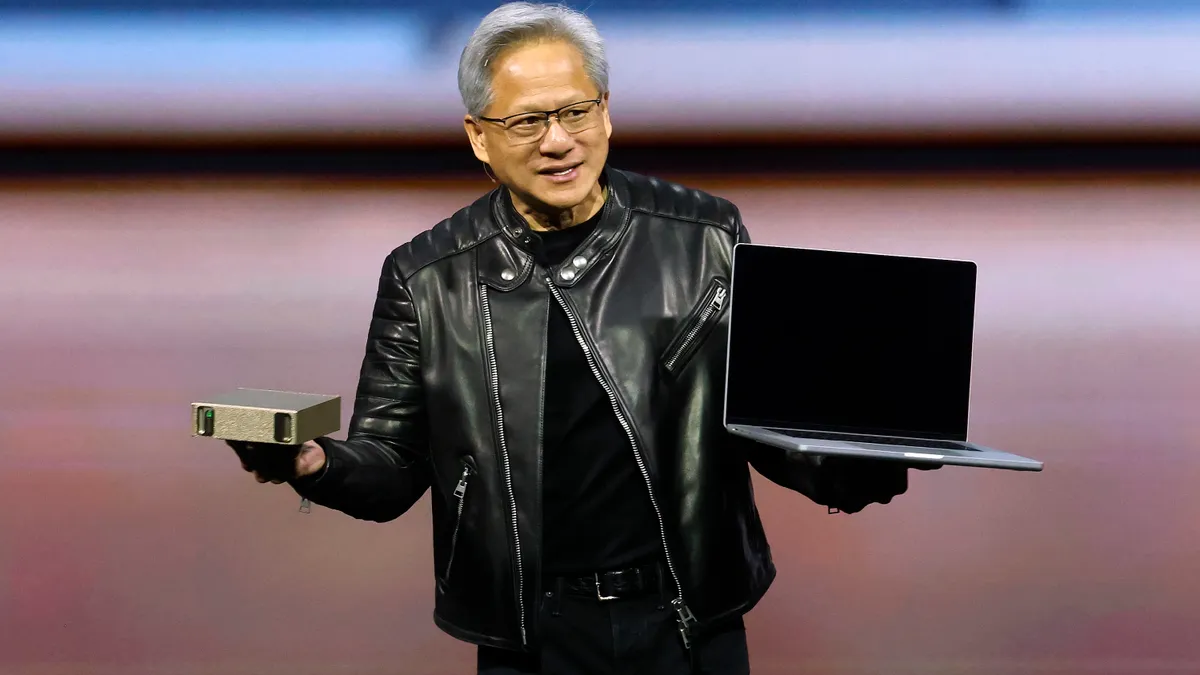
- Nvidia is acquiring open-source AI platform Hugging Face for $12.9 billion, Nvidia CEO Jensen Huang confirmed in a Thursday blog post, marking the chip maker’s foray into AI operating systems rather than just foundational hardware.
- The company plans to scale Hugging Face’s platform to expand access to open models for the developer community, Huang said in the blog post. More than 200,000 companies use Hugging Face to deploy AI, and under Nvidia’s ownership it will remain an open platform for the AI ecosystem while continuing to support multicloud and multi-accelerator development and deployment, Huang said.
- The deal could bring additional security resources to the Hugging Face platform while providing CIOs with greater reliability and better model evaluation tools, Nick Patience, VP and practice lead of AI platforms at The Futurum Group, told CIO Dive. “With the Nvidia resources behind it, I expect Hugging Face to play a more prominent role in the future.”
Dive Insight:
The acquisition is Nvidia’s second largest on record, following a $20 billion purchase of assets from chipmaker Groq in December, as it aims to further propel its leadership in the AI market.
The deal is a bet on the growing ecosystem of open-source and open-weight models, which allows companies to cheaply build AI capabilities without training models from scratch. Meta, Alibaba and Google are major open-source model players, but the market has become increasingly noisy with smaller upstarts including DeepSeek, which launched DeepSeek-R1 in 2025, gaining ground.
“[Open-source models] enable organizations to match the right model to the right job,” Huang said in the blog post. “That is how AI can advance safely, strengthen cybersecurity and sovereignty, accelerate innovation, and reach factories, hospitals, farms, classrooms and Main Street businesses around the world.”
Although the acquisition brings an essential hub for open models under the umbrella of the world’s most valuable company, AI experts said they don’t have any initial concerns that the deal will impact the open-source ecosystem or enterprises that use open models drastically.
“It is in Nvidia’s interest to keep Hugging Face’s community as open as possible, similar to Microsoft's acquisition of GitHub,” Lian Jye Su, a chief analyst at Omdia, told CIO Dive.
Nvidia has a strong track record with open-source software and models in recent years, Su said, including the rollout of its Nemotron model family, a multimodal open model built for self-evolving agents. He added that he believes Hugging Face will continue to be a go-to community for AI models without promoting specific tie-ins to Nvidia’s GPU or accelerated computing frameworks.
“[Nvidia] is obviously looking to vastly increase its developer community via this deal, but it already dominates AI compute regardless of who owns Hugging Face,” Patience said.
CIOs won’t see much impact around cost because of the deal — Futurum data shows just under 30% of enterprises procure models via a hub or marketplace, and most go straight to a cloud or AI provider, Patience said.
But a risk of reduced negotiating leverage over time could pose issues in the future, he added.
Another factor CIOs should consider is potential security risks, Patience said. Hugging Face’s infrastructure was breached by OpenAI models during cybersecurity testing in July. The breach joined a collection of incidents from this year that highlights how much access powerful AI models can gain.
But the Nvidia-backed resources Hugging Face will now have access to could help ease some of these concerns, Patience said.
“If Nvidia invests in the platform reliability and model evaluation tooling it says it will — and I’d be astonished if it doesn’t — that could actually hand CIOs better provenance and vetting tools than they have today,” he said.
Disclosure: Informa owns a controlling stake in Informa TechTarget, the publisher behind CIO Dive and parent company of Omdia. Informa has no influence over CIO Dive's coverage.