

Dive Brief:
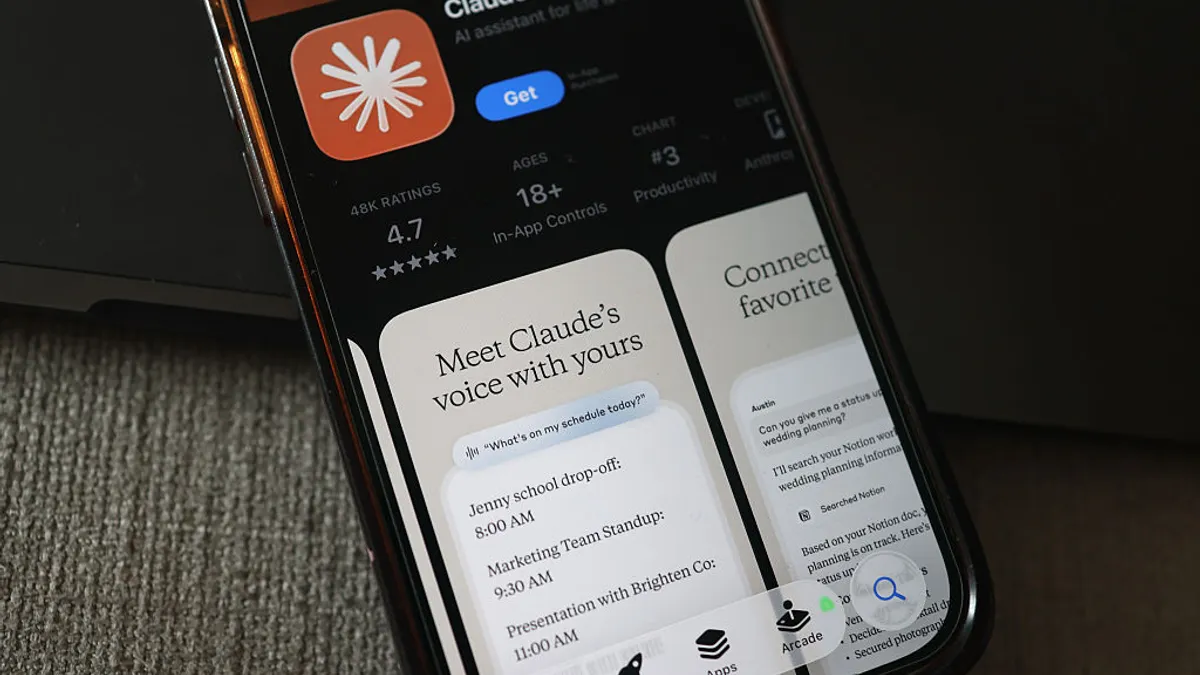
- Anthropic's Claude now lets subscribers use their phones to complete tasks on their computers as providers seek to expand autonomous capabilities, the company said Monday. The feature is available under a research preview for Claude Pro and Max users.
- Users can now perform a variety of tasks, such as create a report from local files, fill a spreadsheet with data from multiple sources or export a pitch deck as a PDF for a meeting, from their phone. Claude completes tasks by first seeking a “connector,” like Gmail, Google Drive or Slack on a computer, Anthropic said Tuesday in an update to Claude’s support section.
- The update is the latest in a string of AI companies’ attempts to pilot AI agents to complete tasks autonomously following the release of OpenClaw, which surged in popularity last month.
Dive Insight:
Vendors are aiming to take advantage of the interest in agentic AI capabilities as CIOs and other tech leaders seek more autonomy in company operations.
Claude's new feature runs locally on a user’s device, similar to OpenClaw, which deploys through apps like WhatsApp or Telegram to complete tasks on a computer.
Also like OpenClaw, Anthropic’s tool comes with security warnings.
The company cautioned users to be mindful of what information the tool has access to, as it takes screenshots of the computer to navigate tasks. It is trained to avoid certain information like stock trading and facial images, the company said. Sensitive information like medical or financial records should be closed before deploying Claude in this way, the company said.
Security concerns of agentic AI agents have been flagged by company leaders at Meta and other tech firms, citing potential privacy breaches. Although the desire for agentic AI adoption is accelerating, only one in five companies who plan to deploy it in the next two years have a mature model for governing AI agents, a recent Deloitte study found.
But developing AI agent technology has been heralded by Nvidia CEO Jensen Huang as the “next ChatGPT.” At the company’s GTC Conference earlier this month, he told attendees that “every company in the world today needs to have an OpenClaw strategy, an agentic systems strategy.”
Nvidia launched its own open enterprise AI agent platform, NemoClaw, built on top of OpenClaw earlier this month, adding to the vendor race to make emerging products ready for the enterprise. It’s built with enterprise-grade security and privacy features to make OpenClaw a more secure platform, the company said.
“This seems to be the next step of the evolution of the Gen AI story,” said Lian Jye Su, a chief analyst at Omdia.
Su agreed with Huang that there is a wide drive across the industry to adopt agentic AI tools, but said it will likely take different forms from OpenClaw’s. CIOs will need a strategy for their company, be it self-built AI agents or platforms released by tech providers.
In any enterprise technology innovation, there’s a “push and pull” over security concerns, Su said.
“AI vendors want things to be fast, to go quickly, to break things,” he said. “But I think fundamentally, for most enterprises, they do want to be slower. They do want to make sure things are being done the right way.”
Fears that tools like OpenClaw could displace SaaS offerings are historically unfounded, Su said. He believes it could be years before a true replacement of enterprise tools happens. By then, traditional SaaS vendors will have likely developed their own agentic tools.
“A truly differentiated and truly powerful SaaS solution has built-in security, a built-in enterprise grade reliability into it that cannot simply be replaced by all these emerging agents,” Su said.