

Editor’s note: This article draws on insights from a May CIO Dive virtual event. You can watch the sessions on-demand.
CIOs are no longer back office technology experts who keep the lights on. Instead, AI has disrupted the role, turning tech leaders into intelligence orchestrators responsible for connecting platforms and ecosystems and turning insights into action.
That’s according to a panel of speakers during Wednesday’s CIO Dive virtual event on how AI is reshaping the enterprise. The rapidly evolving technology has pushed CIOs into the spotlight as CEOs look to technology leaders for answers on how to implement AI in a way that’s meaningful for the business. Eight in ten CIOs have seen their roles expanded to help meet business objectives with more than a third managing a profit and loss statement, according to Deloitte.
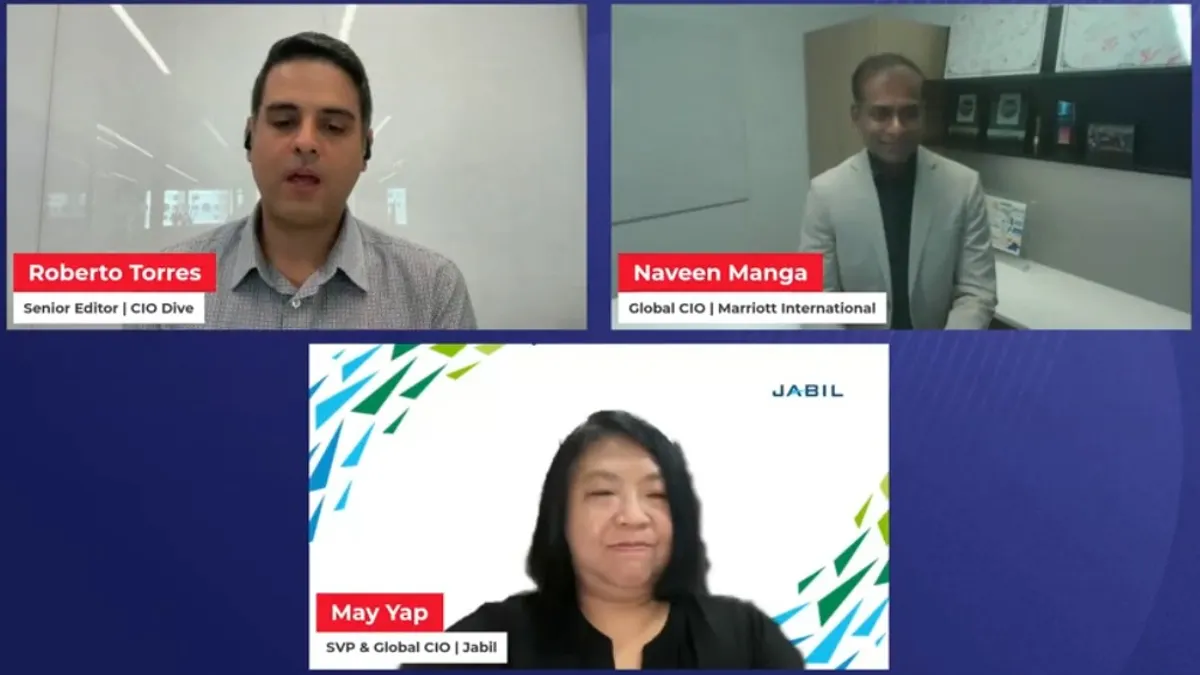
The traditional CIO role focused on aligning a technology strategy with overall business objectives to drive value, executing to deliver business outcomes and bringing in talent, Naveen Manga, global CIO at Marriott International, said during the virtual panel discussion.
“But with AI, that paradigm has tweaked,” Manga said. “The role of the CIO is becoming an orchestrator of intelligence.”
Beyond information technology, CIOs are now focused more broadly on enterprise technology and working with the enterprise to not only deliver business outcomes but understand levers to increase revenue, reduce costs and excite customers, May Yap, SVP and global CIO at manufacturing company Jabil, said during the virtual event.
AI has created new leadership traits that define CIOs besides simply being knowledgeable about new technologies, Yap said.
“That is a baseline. That is not your differentiator,” Yap said. “The differentiator for a CIO is how do you actually appreciate a business problem, how do you actually help your business solve a practical problem or rethink or reimagine how things need to be done.”
CIOs scale AI
At Marriott, 2025 was a year of experimenting with, learning about and piloting AI, Manga said. This year, it’s about scaling the technology.
Marriott has taken a deliberate approach to AI use cases, focusing on unlocking value for guests, employees and owners.
“The goal is not to apply AI in pockets,” he said. “We are not splintering our efforts. We’re bringing it all together into this portfolio approach of value creation and delivery across the three customer personas.”
For hotel guests, Manga said his team is working on an agentic and generative AI interface for desktop and mobile apps set to launch at the end of the second quarter of 2026 to support complex queries, such as hotels near a beach or close to walking trails and what babysitters are in the area.
Manga’s team is also working to build a single pane of interfaces and technologies providing data to front desk employees. Meanwhile, for owners, Manga’s efforts are focused on creating a platform that provides insights into hotel operations.
At Jabil, Yap said she is also focused on scale. While creating an AI pilot in one manufacturing plant can be a simple task, she said she wants to be able to replicate projects across the company’s global manufacturing network.
“What we are focusing on now is really to industrialize all these AI projects and turn experimentation into something repeatable, reliable and embedded into our day-to-day operations,” she said.
Looking ahead, Manga said he’s preparing for a world with hundreds of thousands of digital agentic workers, augmenting and assisting the human owners of those agents.
“That requires a completely different way of thinking and enmeshed technology where you can securely be able to orchestrate this collection of future agents,” he said.