Dive Brief:
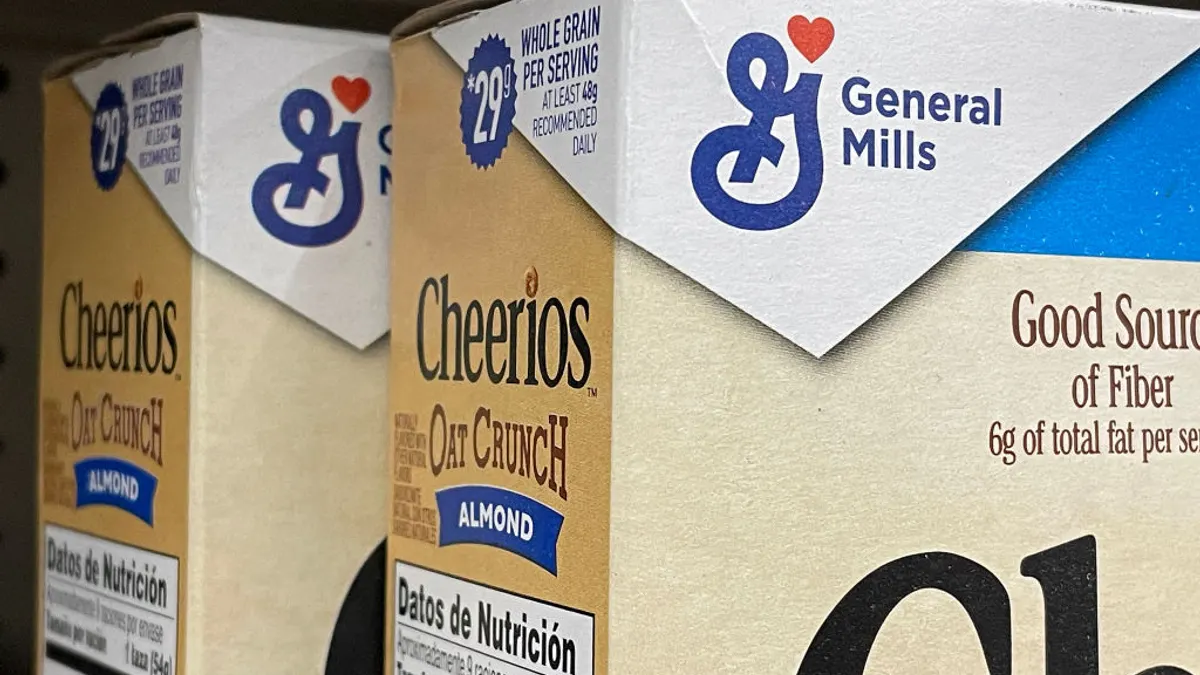
- After six years as chief digital and technology officer at General Mills, Jaime Montemayor added transformation to his title, the company confirmed to CIO Dive in an email last week.
- In the expanded role, Montemayor now leads the transformation office and global shared services organization in addition to the digital and technology team. The change was effective in March, the company said.
- "With this broader scope and a connected team, I’m energized by the opportunity to accelerate our strategic initiatives and drive growth in the years ahead,” said Montemayor in a LinkedIn post.
Dive Insight:
Montemayor’s leadership expansion at General Mills is playing out as the company undergoes a three-year transformation effort that kicked off last year. The transformation program seeks to cut costs and boost growth as the company expands its use of digital tools.
"We're now leveraging artificial intelligence to support new product development: from using digital personas to better understand consumers and customer problems, to image generation that creates prototypes in seconds,” said CEO Jeff Harmening, speaking in February during an investor conference. "Our teams are now moving from generating hundreds of potential consumer solutions to thousands, helping improve the quality of our ideas while increasing our speed of idea generation."
The company's Holistic Margin Management productivity program will lead to 5% gross savings in the cost of goods sold during fiscal year 2026, driven by the company's supply chain improvements, Harmening said in March during the company's Q3 2026 earnings call.
The margin management effort and the transformation initiative will jointly contribute $600 million in savings during the 2026 fiscal year, Harmening said. The company posted net sales of $13.8 billion during the quarter, down 7% including a five-percentage-point headwind from the divestiture of its U.S. and Canada yogurt business and the acquisition of North American Whitebridge Pet Brands operations.
As transformation efforts continue, General Mills in March announced plans to divest its Brazil operations, including local brands Yoki and Kitano to Grupo 3corações.
Generative AI adoption has delivered value for the company across multiple applications, including supply chain and marketing, Montemayor told CIO Dive in 2024. The effort required improving the foundational technologies of AI in a broad modernization push.
“We were a traditional company when we started this journey, and we knew that we had to make investments, particularly in data science,” Montemayor said, speaking during a virtual event. “Slowly but surely, over the last four years, we’ve been building our talent foundation to enable our AI program.”
Other leading businesses in the food and beverage sector are also bolstering their tech capabilities as they respond to shifting consumer patterns, rising ingredient costs and macroeconomic headwinds.
Hershey is eyeing a potential $100 million inventory cut and a $50 million productivity boost over the next two years from the adoption of decision-intelligence software in its supply chain. Meanwhile, PepsiCo spun up digital twins of its factories through a multiyear pilot with Nvidia and Siemens announced in January.