

Dive Brief:
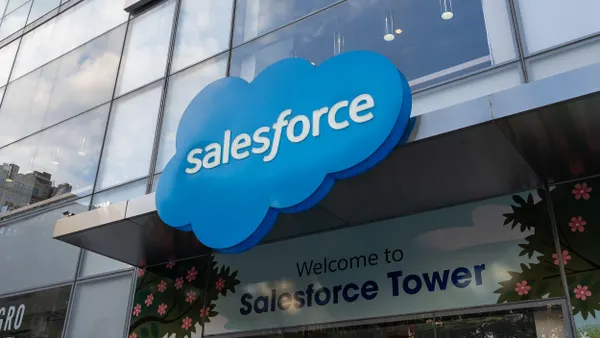
- More than 4 in 5 IT leaders believe the proliferation of AI agents will yield more complexity than value due to integration challenges and silos, according to the 2026 Salesforce Connectivity Benchmark Report published Thursday. The company partnered with Vanson Bourne and Deloitte Digital, surveying 1,050 IT leaders for the report.
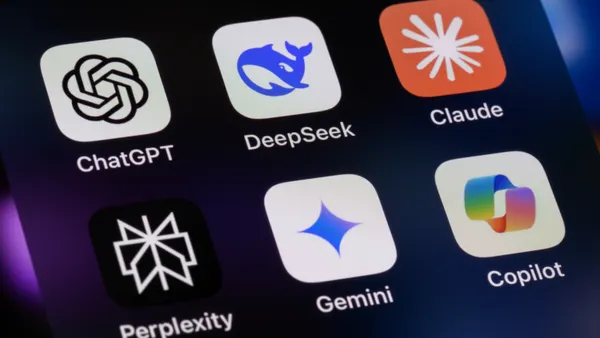
- Enterprises use an average of 12 agents, a number that’s expected to increase to 20 by 2027. Yet agentic AI’s long-term effectiveness hinges on data integration, according to 96% of IT leaders. The average organization manages 957 applications, but only 27% of those applications are connected due to data fragmentation, meaning agents lack access to the data they need, the report found.
- Nearly all enterprises experience data barriers for AI use cases, with 64% of IT leaders expressing concerns about their ability to meet AI implementation goals.
Dive Insight:
As enterprises continue to adopt AI agents, IT leaders face the growing challenge of orchestrating and enabling a multiagent ecosystem.
The Salesforce report found that agents working in silos can lead to disjointed workflows, redundant automations and a higher risk of shadow AI — the unauthorized use of AI tools.
Integrating siloed apps and data remains a primary hurdle for 35% of survey respondents. IT leaders are assessing APIs as one way to connect AI agents, according to the report. One-third of IT teams are already using APIs to speed integration across systems.
Agents need to be treated as part of a connected ecosystem that’s solving a customer or an internal-facing issue, said Kurt Anderson, managing director and API transformation leader at Deloitte Consulting LLP.
“To be effective, you have to reimagine that integration strategy,” Anderson said during a press briefing on Tuesday. “It means building that API-driven architecture and using the API layer as that connective tissue for the enterprise. This foundation enables agents to have a secure path to data in the context it needs to deliver value.”
Alcon, an ophthalmology company, is using MuleSoft Agent Fabric to govern its AI agents. MuleSoft is an integration platform Salesforce acquired in 2018.
“Building agents across will not only improve our products but it allows us to move faster to the market,” Sreenivasa Patibandla, director of system integrations and APIs at Alcon, said during the press briefing. “We are building the platform to create the agents, to govern them properly.”
More broadly, the industry is still searching for a common language to orchestrate agent interactions across vendors as adoption grows, Andrew Comstock, SVP and GM of MuleSoft at Salesforce, said during the Tuesday press briefing.
“Enterprises aren’t just sitting on one agent,” Comstock said. “This creates the multiagent enterprise, where agents from different vendors and ecosystems — Agentforce, Amazon Bedrock, Google’s Vertex AI and more — must coexist and collaborate.”
AI vendors have worked to build open standards for agentic AI that will allow tools to communicate with each other across vendor platforms.
In December, the Agentic AI Foundation was created and co-founded by Anthropic, Block and OpenAI with support from Google, AWS, Microsoft, Cloudflare and Bloomberg, to offer a neutral foundation for AI agent standards development.