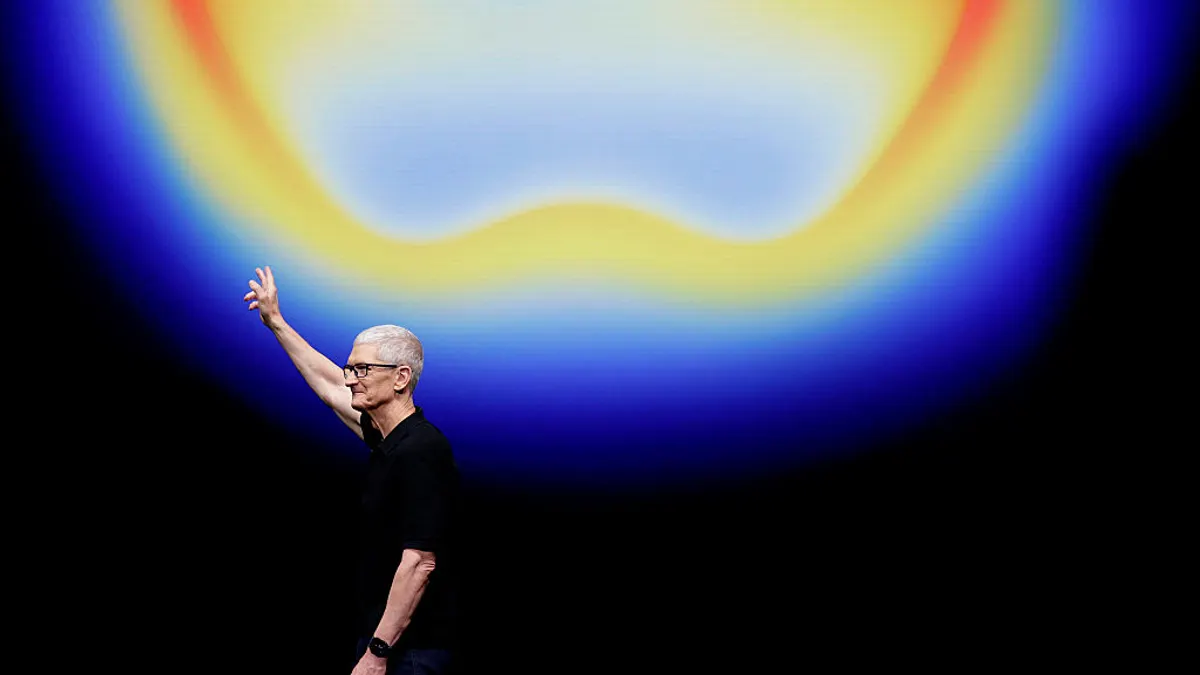
Apple CEO Tim Cook, a driving force behind the company's storied run toward a trillion dollar valuation, carved out a place for the iPhone maker in the enterprise while navigating seismic shifts in cloud computing, business operations and AI.
After a nearly 15-year stint as CEO and nearly three decades with the company, Cook will become executive chairman of the board Sept. 1, handing the reins over to John Ternus, SVP of hardware engineering. While the company's efforts have centered on consumer-focused innovation, Cook also saw the potential for business customers to help drive growth.
Enterprise markets “represent a major growth vector for the future,” Cook said during a 2015 earnings call, touting significant growth and what was then a $25 billion slice of annual revenue for the company. In the years that followed, the company shipped scores of enterprise-ready Mac computers, iPhones and other devices in support of enterprise operations.
The trend has continued since. Although the company hasn't reported enterprise sales numbers in years, Apple has highlighted a stable of enterprises deploying thousands of Apple devices in each earnings call — most recently Snowflake, AstraZeneca and Mexico-based retailer Coppel.
“Tim Cook turned the Mac from a design-led outsider offering into a credible enterprise client by aligning it with mobile-first IT,” said Dion Hinchcliffe, VP and practice lead, CIO and technology buyers, at The Futurum Group, in an email to CIO Dive. "But his biggest legacy is decisively making iOS an enterprise staple. Under his leadership, the iPhone became the de facto front door to enterprise apps and identity around the world, even in shops that remain Windows-first on the desktop today.”
How Ternus, a mechanical engineer by trade and a longtime Apple executive, decides to proceed in the enterprise market remains to be seen.
Entering the AI era
The tech sector rush toward AI did not escape Apple, but the provider took a different approach compared with the world's biggest technology companies.
In January, Apple selected Google's Gemini models and cloud technology to power its own foundation models as part of a multiyear effort. The year before, Apple unveiled a $500 billion package of U.S. investments largely aimed at expanding its own compute and AI capabilities.
Much like Cook led Apple through pivotal years, Ternus will be tasked with future-proofing Apple amid the acceleration of AI — especially in the enterprise.
“For CIOs, the signal to watch now is whether Apple Inc. can deepen its enterprise control plane, meaning identity, security posture and AI/endpoint orchestration,” Hinchcliffe said. “Just remaining a premium client within Microsoft- and Google-centric ecosystems will squander what Cook achieved.”
To strike the right note with enterprise customers as AI evolves, Ternus must focus on simplicity as he addresses CIO demands, according to Bola Rotibi, chief of enterprise research at CCS Insights.
“He’s got to be conversant in terms of where enterprises are looking to move, ensuring hardware, software and services are aligned from an enterprise perspective,” Rotibi said. “[CIOs] are going to be thinking about AI, because that’s something that is coming to all enterprises.