

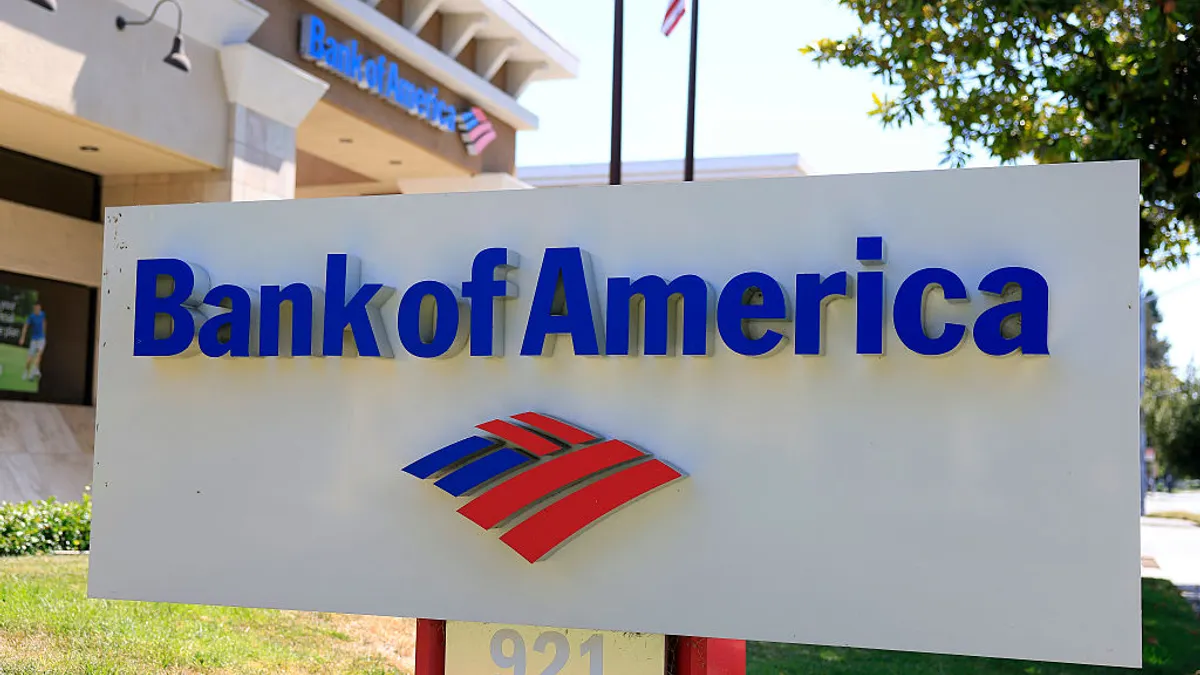
Bank of America is advancing its AI strategy as it finds ways to move beyond task-specific pilot projects and toward process transformation.
The financial institution established an AI strategy centered around governance, innovation sessions and problem solving. Last spring, the bank reported that more than 90% of its roughly 213,000 employees are using its Erica for Employees virtual assistant and documented more than 3 billion client interactions with the bank’s customer-facing version of Erica.
But the bank isn’t sitting idle. During the Semafor World Economy 2026 event Tuesday, Hari Gopalkrishnan, chief technology and information officer for Bank of America, outlined four primary areas, including end-to-end process transformation, scale and reuse, governance and ROI, that are currently driving AI project success.
“The big pivot from last year to this year I’d characterize in four dimensions, the first is shifting from proofs of concept that were focused on small tasks to actual end-to-end process transformation where you’re going after big opportunities that are going to transform either revenue, client experience or expenses,” Gopalkrishnan said.
Gopalkrishnan said the technology can save employees time and improve relationships with customers. The bank’s wealth management firms recently rolled out AI-Powered Meeting Journey, leaning on its Salesforce CRM data, to provide AI-enabled assistance for its financial advisors before, during and after client meetings.
“Today, we can understand prospects, identify them, create meeting summaries, help meetings and the whole process goes from days and weeks to hours,” he said.
Governance and ROI
Scale and reuse is a major focus area for the bank, Gopalkrishnan said.
Bank of America, which allocates 30% of its $13.5 billion technology budget for new initiatives, including AI, is focused on shifting away from individual teams building applications to enterprisewide capabilities that can be reused repeatedly, he said. The bank supports roughly 3,000 processes and is looking at AI as a foundational element to be scaled and used across those operations, he added.
Scaling AI across the enterprise leads to another primary focus area — governance.
“This stuff is very hard to govern,” Gopalkrishnan said. “If you overdo it, you stall innovation. If you underdo it, you introduce a lot of risk.”
Enterprises expect to increase generative AI spending by nearly 40% in 2026, which means AI will be more deeply embedded into business workflows, creating a need for stronger guardrails, according to Gartner.
Lastly, ROI has become a critical component of the bank’s AI strategy, Gopalkrishnan said. AI adoption is expected to trim banking industry costs by up to 20%. However, legacy IT systems that make scaling AI difficult and lack of alignment on what translates to AI ROI are muddying the waters.
“A year ago, we probably just said, ‘Let’s try a bunch of stuff out,’” Gopalkrishnan said. “We’re at a point where we say, ‘Before we try a bunch of stuff, let’s understand where this is going to take us from an ROI perspective.’”
Data is the foundational component behind all of the bank’s work with AI, Gopalkrishnan said. Along with data, implementing a compute strategy and understanding the economics of running AI models is key, and where FinOps plays an important role, he added.
“These models aren’t cheap, they take a lot of hardware to run,” he said. “It’s very easy to spend a lot of money and find out that you’ve got nothing in return.”
Upskilling employees also plays a significant part in Bank of America’s AI strategy, Gopalkrishnan said. The bank established an academy focused on reskilling and upskilling employees on AI. The academy provides employees with different AI training programs, from basic prompt engineering to AI design and development.
The bank filled 44% of jobs in the last few years through internal mobility, partly as a result of upskilling, he said.