

Dive Brief:
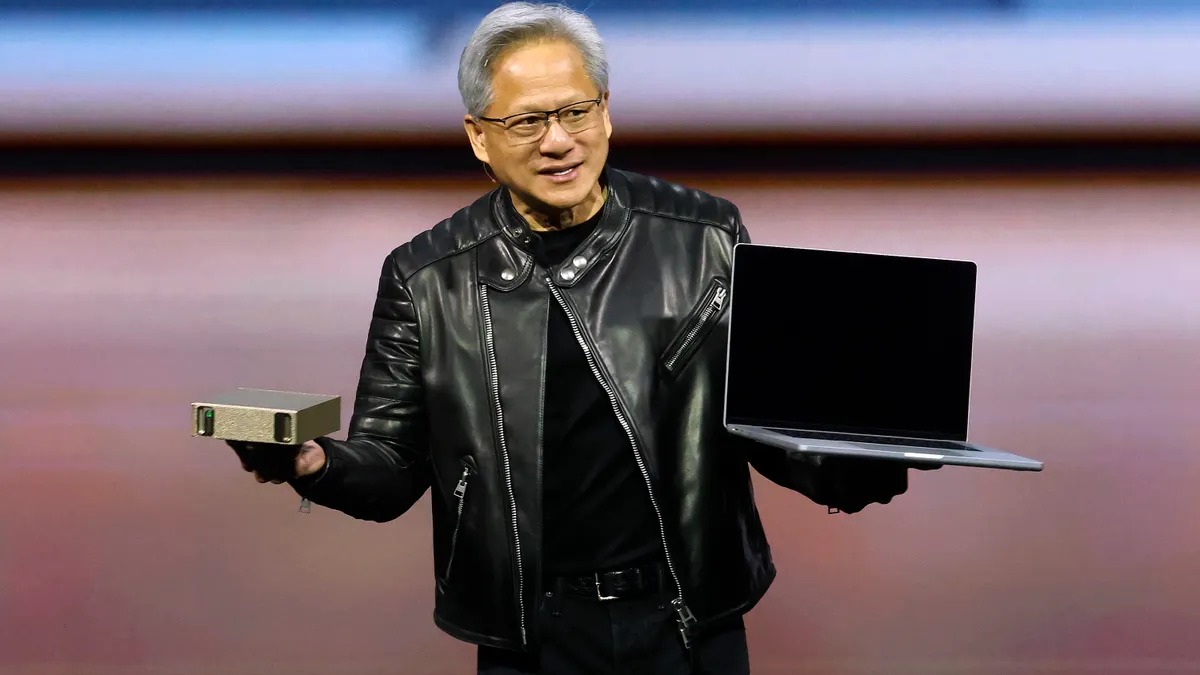
- Nvidia CEO Jensen Huang has stepped down from the company he helped build more than three decades ago, the company’s board of directors confirmed in a Thursday securities filing.
- The resignation follows reports that Huang engaged in two extramarital affairs, one with a suspected Chinese spy and the other with an Nvidia executive who reported to him. The board appointed CFO Colette Kress as interim CEO until a permanent successor is chosen.
- Huang’s departure won’t affect AI infrastructure and companies relying on the tech giant for systems and hardware in the near term, but, the shakeup hands CIOs a strong argument to deliver to company boards on the importance of governance and vendor diversification, Nick Patience, VP and practice lead, AI platforms at The Futurum Group, told CIO Dive.
Dive Insight:
Reliance on Nvidia for systems, hardware and other critical components for the AI era has soared, but the leadership crisis could slowly point CIOs in other directions while the margin for hyperscalers to transition to custom chips widens.
Nvidia’s revenue hit $96.2 billion during the second quarter of its 2027 fiscal year, a figure that more than doubled year over year, bolstered by the company’s infrastructure efforts. Hyperscalers — companies that enterprises rely on to support or provide the AI systems they deploy — have served as a significant growth driver for Nvidia.
Huang’s exit won’t yet affect enterprises’ relationships with hyperscalers, which largely rely on contractual supply and support commitments that Kress is well-positioned to carry on, Patience said. However, the crisis could cause CIOs to look more closely at the relationships they tangentially have with Nvidia, Patience said.
“Concentration risk in a single supplier has stopped being theoretical,” Patience told CIO Dive in an email. “I expect more multivendor requests for proposals, particularly for inference, where moving models between hardware platforms is easier than for training.”
Diversification will still be a gradual process, Patience said.
“Switching costs are real and most enterprises reach these chips through cloud providers anyway,” he said. Huang’s exit will create a wider opening for hyperscalers with their own chips, such as Google TPUs and AWS Trainium chips, Patience added.
But Nvidia’s leadership shakeup will also serve as a “stress test for the AI boom,” Stephanie Balaouras, VP, group research director at Forrester, said in an email to CIO Dive.
“Tech leaders shouldn’t overreact, but they should treat Nvidia’s CEO transition as a prompt to reassess concentration risk across their AI infrastructure, suppliers, and investment plans,” Balaouras said.
CIOs can expect few changes in regards to AI infrastructure in the near term, but Huang’s departure could result in disruption down the road, particularly if other senior executives start to leave, Patience said.
Nvidia’s software ecosystem, rack-scale system engineering and supply commitments for manufacturing and memory run years ahead, and the CEO’s exit doesn’t weaken “the depth of Nvidia’s systems,” he said.
However, Huang played an instrumental role in strategic deals and partnerships, as well as long-range bets.
“The current advantage is secure for the next couple of product generations,” he said. “What’s at risk is the quality of the next big bet, and how well Nvidia handles export policy, which now shapes its business as much as any product decision.”
Huang’s ousting will also mean significant scrutiny of the company’s dealings with China, but also enhanced scrutiny for the overall AI industry, according to a Gartner report.