

Dive Brief:
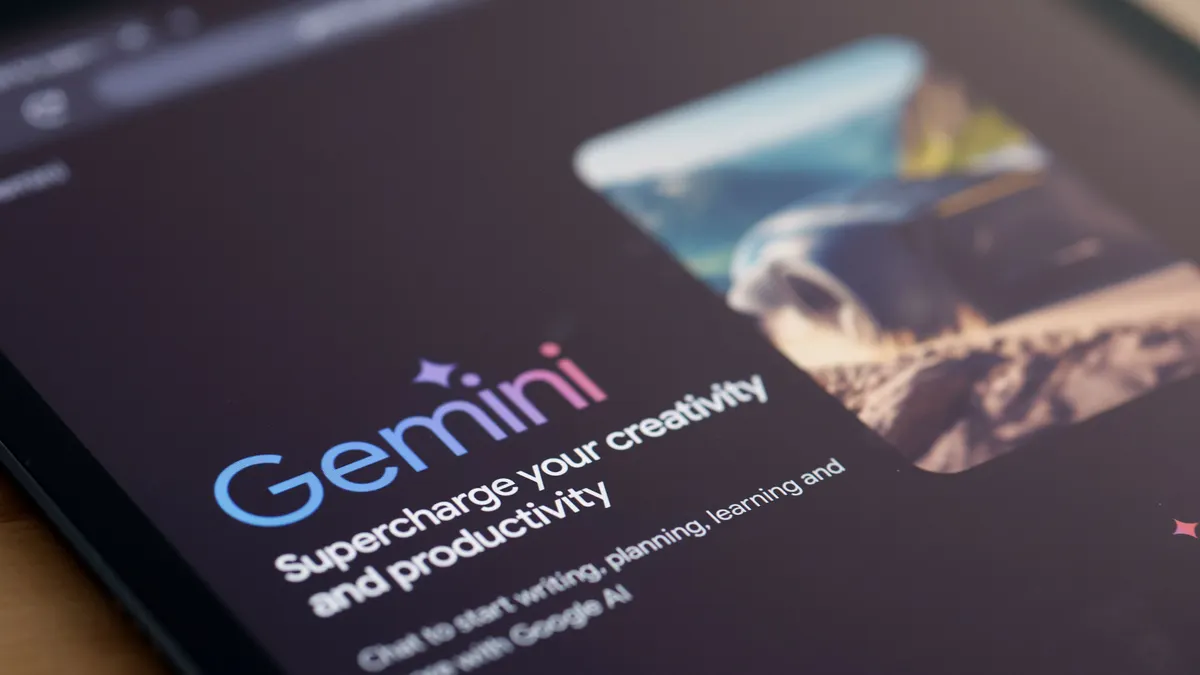
- Google launched Gemini 3.5, a family of models focused on agentic work and personalized task management, at its Google I/O developer conference Tuesday.
- The rollout included 3.5 Flash, a lightweight, cheaper model that will be the default model for the Gemini app, and Gemini Spark, a beta-phase, general-purpose AI agent that can reason using information in connected apps. Omni, a model that can transform text, images and video prompts into cinematic video outputs was also unveiled, as was 3.5 Pro, the company’s heavyweight model, which is currently being used internally and will be available next month.
- The product releases come as the tech giant aims to keep pace with AI agent competitors OpenAI and Anthropic, which are eyeing IPOs, said Nick Patience, VP and practice lead of AI platforms at The Futurum Group in an email. “With Gemini 3.5 Flash, Google is trying to signal that the frontier model race is increasingly about operational deployability, not just benchmark performance.”
Dive Insight:
In keeping with a surge in enterprise AI adoption, Google is positioning its updated models as speedy, agentic AI assistants.
With Gemini Spark and a new agent called Daily Brief, which gives a user a personalized look at their day, Google is competing in a crowded field of AI providers that want enterprise customers to rely on their platforms as they deploy automation.
“The company claims 3.5 Flash delivers frontier-level intelligence at roughly four times the output speed of comparable models, at less than half the cost,” Patience said. “That is a direct response to the inference economics pressure OpenAI and Anthropic are also navigating.”
Agentic and coding agents will force companies to make meaningful changes to their operational capabilities, 80% of CEOs said in a recent Gartner report, as they shift from digital to autonomous businesses. On Friday, xAI waded into coding agent territory with Grok Build, a software engineering and complex coding model.
Half of U.S. businesses have paid subscriptions to AI models, platforms and tools as of last month, according to the Ramp AI Index. While Anthropic and OpenAI own the lion's share of those subscriptions, Google has some features that may gain traction among enterprise tech leaders, Patience said.
Google’s Gemini Enterprise Agent Platform and integrations with Salesforce’s Agentforce and Databricks’ agentic workflows are worth watching, he said. He’s also observing whether Google’s Antigravity orchestration layer meaningfully reduces the integration friction that has kept so many AI pilots from reaching production.
The provider also rolled out the Agentic Data Cloud last month, tools to support adoption of AI agents and a cross-cloud lakehouse that connects an organization’s data estate. Google has also held its ground among the largest hyperscaler providers, holding 14% of the global cloud market in Q1 2026, according to Synergy Research Group.
“Google also has distribution advantages through Search and Workspace that neither rival can match, which may matter more than benchmark comparisons in the long run,” Patience said.