

Dive Brief:
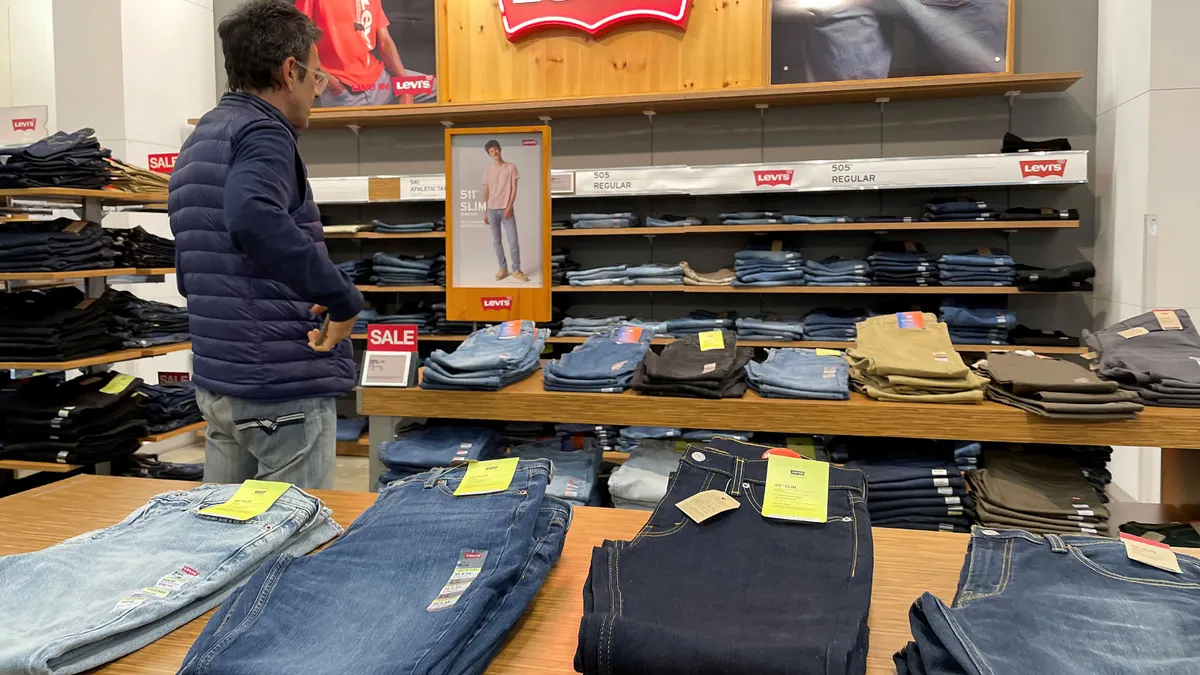
- Levi Strauss & Co. has standardized more than 80% of its business processes globally as part of its multiyear modernization initiative, a significant part of which included migrating onto SAP S/4 Fashion, a cloud-based ERP system, the retail giant said in a Tuesday announcement. Levi’s is a customer participant at this week’s SAP Sapphire 2026.
- The transformation effort has resulted in the retirement of more than 90 legacy systems, enabling more than 2,600 employees to work from a single platform with a common data set and processes, the announcement said. Instead of opting for an ERP system it had to customize, Levi’s adopted SAP’s standard capabilities in an effort to build flexibility into the platform.
- “We didn’t build this platform to solve today’s problems,” Jason Gowans, chief digital and technology officer at Levi’s, said in the announcement. “We built it to move at the speed the market demands and to take advantage of AI and automation capabilities as they emerge.”
Dive Insight:
Levi’s global ERP modernization hinged on creating a single platform as it looked to capitalize on new technologies and adapt to consumer demands while improving operational efficiency.
The retailer is already embedding AI into its ERP system with agents that can process sales orders, manage vendor compliance tasks and capture invoices — actions that previously required a manual lift, according to Levi’s. The company said it worked with SAP to develop an upgrade process that completes in around 20 minutes compared with the industry norm of 48 hours.
Last month, Levi’s completed the migration of operations to its single global ERP platform in 14 countries across East Asia Pacific and China, following go-lives in Mexico, Canada, the U.S., South Africa and India. The company is in the process of migrating operations in the Andes, Brazil and Europe, which are expected to conclude in mid-2027.
The ERP migration is a major modernization initiative, but it’s not the company’s only one. Levi’s is also working with Microsoft to deploy an agentic framework, orchestrated by a “super-agent,” across IT, human resources and operations, and has launched two AI tools — Stitch to help with in-store operations and Outfitting to assist consumers with styling.
“These initiatives are rewiring the company for a bold future, creating meaningful opportunities to enhance consumer experiences while unlocking additional operational efficiencies,” CEO Michelle Gass said during the company’s Q4 2025 earnings call in January.
Other retail companies are also pursuing infrastructure modernization efforts, often a step needed to support AI initiatives. Marzetti, an Ohio-based food company, led a multiyear ERP migration to SAP S/4HANA, laying the groundwork for a more unified foundation for AI and other projects.
In retail, AI stands to have a profound effect on the shopping and buying experience, generating as much as $1 trillion in revenue in the U.S. by 2030, according to an April report from McKinsey & Company and ICSC. Nearly seven in ten consumers said they had used at least one AI tool in the last three months, with 62% using AI to compare brands, prices and reviews.