

Dive Brief:
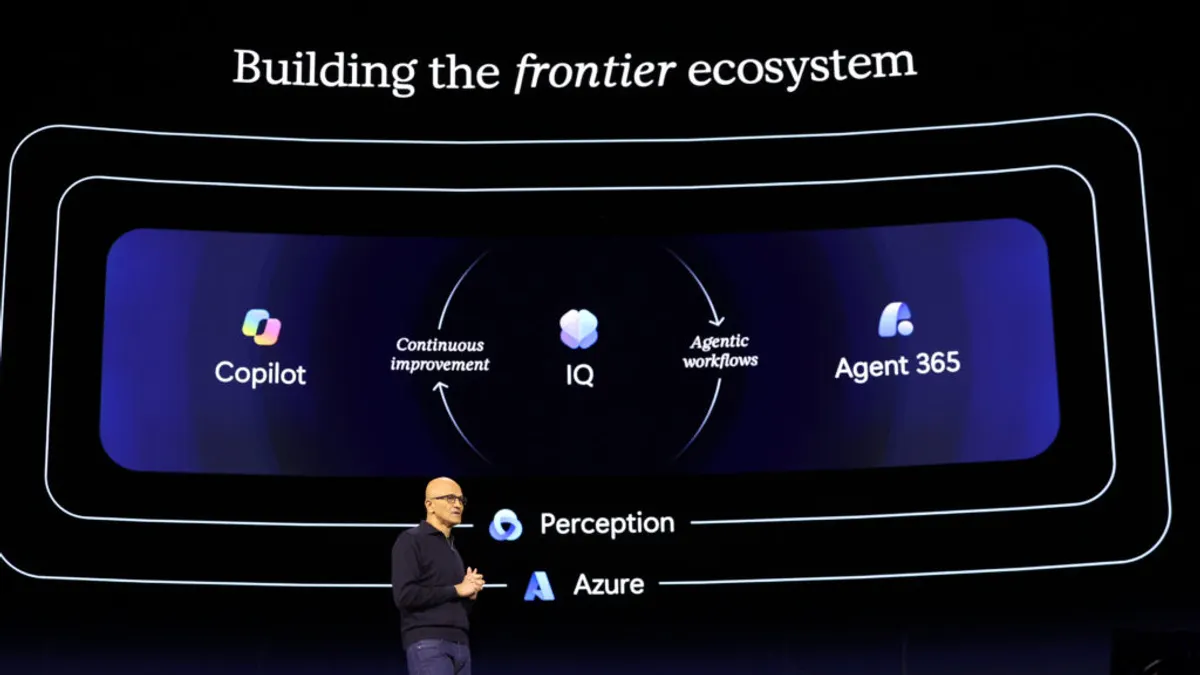
- Microsoft is readying its cloud platform for mulit-agent systems. In a slew of releases and updates at its annual Ignite conference, the vendor made it clear it wants to build unity across cloud infrastructure, chips and models to support AI capabilities and accelerate legacy technology modernization — and Azure is a critical component.
- The hyperscaler expanded Azure’s core AI capabilities and built a new, connected path linking its enterprise AI platform Microsoft Foundry to its Azure Kubernetes Service (AKS) for AI workload choice. It also launched Azure Catalyst, a platform that uses agents to discover applications, map dependencies, provide cost comparisons and generate migration waves, on Tuesday.
- Microsoft spent years reengineering Azure to support AI demands, Jeremy Winter, corporate VP and chief product officer of the Azure Platform, wrote in a blog post. “That work has forged Azure into a single, co-engineered system, with models, silicon and cloud infrastructure tuned as one and value compounding at every layer.”
Dive Insight:
Hypersalers are rapidly building out entire ecosystems to support AI and earn enterprise spend.
Global AI spend is projected to reach $2.7 trillion in 2026, with tech providers such as Microsoft, Google and Amazon leading the charge as they build out infrastructure to run AI models and agents, according to analyst firm Gartner.
Hyperscalers, in particular, are diversifying the AI capabilities they provide and support, which includes developing custom-built chips for their cloud platforms. Last month, Microsoft said it plans to make its Azure Maia chips, a family of application-specific integrated circuits, the primary inference system for its products and services. The company is aiming for its Maia 200 chip to support Microsoft Foundry workloads by the end of 2026.
At Ignite, Microsoft announced general availability of its custom-designed processors, Azure Cobalt 200 virtual machines, built to deliver up to 50% better CPU performance compared with Cobalt 100 VMs. The company also touted new capabilities for building and deploying agents, including the introduction of Microsoft IQ, an enterprise context management platform, for providing critical business context to agents.
Microsoft isn’t the only hyperscaler expanding its reach across the AI supply chain. Google has developed its own tensor processing units and launched a joint venture with Blackstone to provide compute as a service to enterprises. Meanwhile, AWS CEO Andy Jassy said the company is on its way to a $1 trillion valuation, noting revenue growth in the company’s Trainium and Graviton chips during AWS’s Q3 2026 earnings call last month.
“Our chips business continues to grow triple-digit percentages year over year, and revenue commitments for Graviton and Trainium have each increased more than 20 times year over year,” he said during the call.
Microsoft, Google and Amazon’s increasingly diverse portfolios better position the companies to compete with chip giant Nvidia, which faces ongoing fallout from CEO Jensen Huang’s resignation after a series of extramarital affairs.